Showing posts with label Best Of. Show all posts

Sunday, December 26, 2010

THE TOP 10 ALBUMS OF 2010

10. Fang Island (by) Fang Island
Math Rock / Indie Rock / Everyone High-Fiving Everyone
Fang Island seems to be having such a good time playing their eclectic brand of math-rock that it's hard not to wonder if they aren't, you know, fucking with us. These dudes have the rare ability to make fun music without pandering, probably because fun rarely sounds this musically unique. Completely lacking in the hipster irony you'd expect since pop-punk died, Fang Island is as packed full of delicious post-rock textures as it is whiplash inducing riffage. 2010 was a year of fantastic summer albums, and Fang Island's little burst of relentless, guitar-driven optimism should be on everyone's playlist when warmer weather arrives.  Or really, when you just want to pretend.

9.The Wild Hunt (by) The Tallest Man On Earth
Folk / Singer-Songwriter / Blues
It's not important that Sweden's Kristian Matsson happens to sound like a very famous folk musician.  Pretty much every review of The Wild Hunt mentions it, but Matsson deserves all the recognition he gets for his own ample song-writing talents.  And really, it's not much more than obvious talent and a no-bullshit approach to folk that makes The Wild Hunt such a standout album. Matsson is a master guitar player, and his songwriting is tight, lyrical and concise. Confident, affecting, and yet very catchy.  There are few flourishes to the album, but it doesn't need them — Matsson's voice carries these blues, while his feverish fretwork provides the momentum.

8. Marrow of the Spirit (by) Agalloch
Dark Metal / Atmospheric Folk / Progressive
I had incredibly high hopes for Marrow of the Spirit — possibly higher than for any album in the last year or two.  Really, I was certain that any new Agalloch would take the Album of the Year spot, regardless what year it was released.  So for Marrow of the Spirit to land this low is actually a bit of a shock, though I may very well be undervaluing it at the moment.  Agalloch's albums are always unique and slow to unfold, each with its own defined personality; quintessential "growers."  This is a fantastic hour of music, full of haunting textured guitars and powerful, earnest soundscapes, though Agalloch's songwriting seems a bit less focused than on 2006's Ashes Against the Grain.  Possibly on purpose, since that feeling of openness and sprawl allows Marrow of the Spirit to avoid the claustrophobia of true black metal, even as the band occasionally dips into their bleaker roots.  It's a harsher, icer sound that mostly lacks the warmth of their last two albums, but still finds moments of serenity, redemption, and plenty of atmosphere, making this an album one might easily get lost in on a cold winter night.  Hell, even NPR loved it.
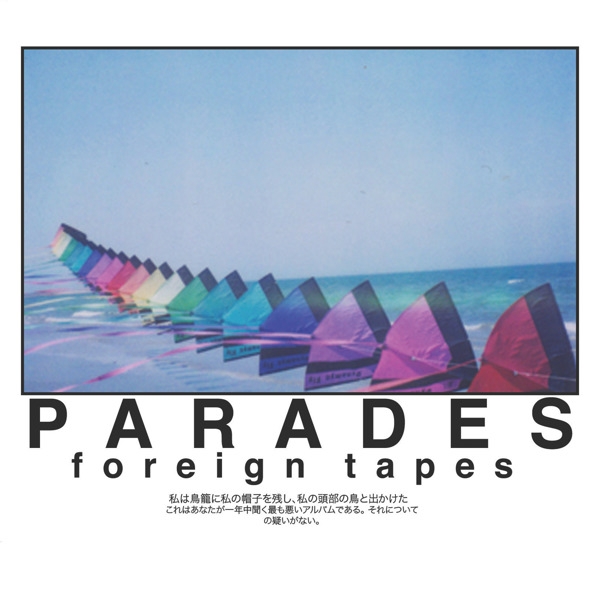
7. Foreign Tapes (by) Parades
Indie Rock / Math Rock / Pop
If you like Broken Social Scene's experimental-indie, jittery pop-rock aesthetic, but think they're a little too sprawling and "anything goes" to make a coherent album, then Foreign Tapes is just what you need.  This haunted summer album manages to hold on to a consistent tone throughout, though that's not to say that Parades doesn't reach to new and strange places.  Track to track, they throw dark, Zeppelin-ish riffs alongside intoxicating drum crescendos and frantically pounding electronics, male / female duet vocals, math-like guitar leads and blaring horns.  It's a strange but fluid menagerie, and shows a personality stronger than any I've heard in indie rock for a long time.

6The Fear Is Excruciating, But Therein Lies the Answer (by) Red Sparowes
Sometimes a band just needs a few albums to get it right.  That's clearly the case with Red Sparowes, who had never particularly impressed me before 2010.  With this, their third album, not much has changed on the surface — they just finally nailed it.  Songs are less meandering, more focused on melody, and Red Sparowes manages to give each track personality without losing the journey of the album as a whole.  Take "Giving Birth To Imagined Saviors," which features one of the best melodies I've heard in a post-rock song in years, or album-closer "As Each End Looms and Subsides," which has perhaps the best climax.  This is the rare case where I'm glad the band didn't try something more experimental, because everything falls into place so flawlessly.

5. Spiral Shadow (by) Kylesa
Sludge Metal / Psychedelic / Progressive
Kylesa may be one of the densest, heaviest metal bands out there, but somehow these Georgian guys and gal have managed to become one of the most accessible too.  On Spiral Shadow, their sound takes one giant evolutionary step into progressive metal. If the Melvins and Built To Spill decided, for some (awesome) reason, to form a super-band, it would sound like this. On first listen, it might seem as if the music is leaner, relying more on atmospherics and psychedelia, but it's more likely that Kylesa just learned how to cram their hundred influences into every moment of riffage.  Psychedelic guitars spiral and bounce back and forth; everything else rumbles along with that good-old buzzsaw crunchiness.  Aided by more forward male / female dual vocals, songs like "Don't Look Back" sound like they could have been radio hits in the early nineties.  It all makes for more opportunities to air-guitar (and double air-drum) than ever.

4. Kvelertak (by) Kvelertak
Metal / Punk / Black'n'Roll
When I first laid eyes on that amazing John Baizley album cover, I figured I was in store for something good, but beyond the Baroness' Stamp of Approval I had no idea what to expect.  Certainly not an Object Lesson in how metal can be unironic, unrestrained, and fun. If Converge gave you the chance to figure out just what the hell was going on before you got knocked out, it'd be this: black'n'roll, punk metal, blackened punk with a dose of sludge. You know how sometimes you're listening to a band that has so much energy, you can't help but appreciate how vibrant and exciting the world can be, and you just want to run up to the nearest person and punch them in the face?  That's this.

3. Dust Lane (by) Yann Tiersen
"French," as a genre tag?  Yes.  I maintain that a few countries are their own genre — somehow, through whatever instruments become standard and whatever cultural associations happen over time, some countries just have a vibe.  The same way you can listen to gritty slide-guitar and instantly conjure images of the southern states of America, something about France has created a tone unique in the world of music.  Yann Tiersen is of course no newcomer — most would probably know him as the composer of the Amelie soundtrack, something which is very, very French.  Tiersen is known for his quirky, folky neo-classical compositions, but Dust Lane shouldn't be taken as anything other than an indie-rock album.  And it's an odd album, to be sure, just not in the way Tiersen's fans may be used to.  Every song features vocals, though most are not exactly singing — Tiersen's voice mixes with that of a female guest in a series of echoey, monotone monologues that somehow fit these songs perfectly.  The mood is dense and yet spectral, the songwriting nearly impossible to pin down for style.  Many indie bands sound like they're throwing a dozen instruments at you just because they can, but Tiersen never shows off; he's just using the right tool for the job, whatever it is he's doing.  A combination of things that are entirely familiar in-and-of themselves, yet produce a sound unlike anything else out there. 

2. Septembre Et Ses Dernières Pensées (by) Les Discrets
If you've been following the underground French music scene over the last few years, you may have witnessed a rare event: the birth of a genre.  It started with Neige, of Alcest, who realized that shoegaze is basically reverse black-metal — and with that wistful French aesthetic and a good dose of folk drizzled on top, you have a style that can't be described with any existing genre tag.  Now, a few years later, Neige's buddy Fursy Teyssier has formed Les Discrets and pushed the music further away from its black metal undertones and deeper into some strange folk / post-punk fantasyland.  Some have started calling the scene "blackgaze," and it's as fitting as anything else. There's a sense of darkness and mourning to Septembre Et Ses Dernières Pensées, the tone a Grimm's Fairy Tale would have if converted into music. It's dense, too, but that brings us to the shoegaze, the thick, eerie post-punk sound. That the lyrics are all in French only adds to the atmosphere, as Fursy's voice drifts through songs like a dense but small fog, sometimes joining a female vocalist to brighten the atmosphere without abandoning melancholy.  The album occasionally seems hurried to deliver, but when Fursy takes time to slow the narrative and open up each piece, Septembre Et Ses Dernières Pensées displays some of the most beautiful, surreal sounds I've ever heard.

1. Gifts From Enola (by) Gifts From Enola
Post-Hardcore / Post-Rock / Progressive 
When I reviewed last year's phenomenal From Fathoms, I spent some time trying to figure out just what makes Gifts From Enola so memorable and fresh, for what seems at first like standard guitar-driven post-rock. But by now, it's obvious that post-rock was a red herring.  Surprise!  Gifts From Enola is actually an instrumental post-hardcore band that happens to have a love for post-rock atmospherics.  While From Fathoms remains my favorite of their albums — it's more sprawling and more of an adventure, and I happen to like every detour it takes — the Gifts guys wisely acknowledged their sudden identity-acceptance with this self-titled.  The meandering post-rock subtleties of their very early material is mostly gone, replaced by confident, denser songwriting and nuclear stockpiles of energy.  Vastly improved production values help showcase that unbridled hardcore adrenaline, but these songs would still sound relentless if Justin Bieber's backup band covered them.  This album could hurt you.  Drums are pushed way up in the mix, thudding and propulsive as a cannonade; each hit sounds like something died as a result.  Every bass line sounds something you'd pay money to ride.  The guitars drive it all to a breakneck pace, and remain some of the most versatile in any scene, instrumental or otherwise.  Nothing is outright super heavy — there are no breakdowns like in last year's monstrous "Trieste" — but only because the songs move too fast, mixing grittiness with serenity, and often at the same time.  Take Alagoas, which has quickly become one of my favorite songs of all time (and probably would have been my Album of the Year even if they'd released it as a single.)  The song is a perfect summary of everything Gifts From Enola does so brilliantly, without being too flashy about it.  I can't think another post-rock or post-metal band that's able to conjure as many fantastic riffs as these guys, and still spin that guitar-driven density into something that's also multi-layered, suggestively textured and fully coherent.  For every shift and switch-up, the music never loses focus, and Gifts' personality is clearer than ever before.  It may not be their most ambitious album, or even a perfect one, but this is unquestionably their defining album.  Gifts From Enola's music has a remarkable vitality, the ability to sound fresh and interesting even after dozens and dozens of repeated plays.  An achievement like that takes more than creative genre-bending, or even passion.  There's no equation I can think of to give a record such energy — but whatever it is, Gifts From Enola has it.

Monday, December 20, 2010

THE TOP 10 ALBUMS OF 2009, IN RETROSPECT


It's become a sort of obligatory internet tradition for music sites to post their "best of" lists at the end of each year.  I enjoy the tradition as much as anyone, but I'll be the first to admit that it's a flawed concept.  Once music passes a certain point — arriving in the mercurial netherworld of Objectively Good Music — it becomes extremely difficult to critique or compare it without stumbling through the magical wardrobe of Extreme Subjectivity.  If you've found ten albums from a year that were all excellent, what makes any one of them better than the others, except that you liked it more?  Past a certain point, your own personal appreciation is all that matters.  Thus new music often goes through a cycle: discovery, heavy rotation, over-exposure, then sitting around for weeks without another play.  This makes it hard to decide what albums even you yourself really liked at the end of a year, since some of them may be fresh releases, while others have been in your collection for nearly a year already.

That's why, here at The Luxury Yacht Review, I'm going to take the time to check back in a year later and re-evaluate what lasted the test of time — and what albums I may have simply missed the first time around, despite my best efforts to listen to everything and anything. And I will also admit — many albums I listened to in 2009 just didn't hit me until much later.  But now is the time to make amends.  In retrospect, 2009 was one of the best years in history for my music collection, though I scarily realized this last year.  My favorite albums from last year just became favoriter, and releases I only discovered after my list was compiled ended up blowing me away just the same.

Here is my Best Of 2009, as it stood last year:
1. Sol Eye Sea i (by) Irepress
2. Daisy (by) Brand New
3. From Fathoms (by) Gifts From Enola
4. Gin (by) Cobalt
5. Hollow Be My Name (by) Eleventh He Reaches London
6. Sunden (by) The Waters Deep Here
7. Dyad 1909 / Found Songs (by) Olafur Arnalds
8. Axe to Fall (by) Converge
9. The Other Truths (by) Do Make Say Think
10. Eras (by) Apse

It was an okay list, full of albums that impressed me with their originality and innovative genre blending.  But technical merits don't always equal lasting, emotional resonance, and with the discovery of a few newcomers (that is to say, albums from 2009 that I only discovered in 2010), my list looks quite different today.  But one thing hasn't changed: the top half of the list was extremely hard to rank, and any of my new "top 4" albums could trade blows and take the Album of the Year slot.  Many of these albums have settled into my record collection as all-time classics.  So here it is, my revised Best of 2009.

1. Sol Eye Sea i (by) Irepress
2. From Fathoms (by) Gifts From Enola
3. Blue Record (by) Baroness
4. Daisy (by) Brand New
5. Gin (by) Cobalt
6. Axe to Fall (by) Converge
7. The Great Misdirect (by) Between the Buried and Me
8. By the Throat (by) Ben Frost
9. The Other Truths (by) Do Make Say Think
10. Hollow Be My Name (by) Eleventh He Reaches London

Baroness' Blue Record first grabbed me only a week or so after I published my original Best of 2009, yet quickly blew away almost everything else on that list.  From January to March of this year, I listened to pretty much nothing but.  In any other year (including 2010, actually), it would easily grab Album of the Year status.  The Blue Record is like a sludge-metal version of Led Zeppelin III, just faster and denser and heavier.  This is perhaps the pinnacle of the booming Georgian metal scene, a perfectly written, relentlessly energetic bombardment of rock.  Pretty much an all-time classic.  The Great Misdirect is another album I was unfortunately late to the party on.  Over six songs and one hour, Between the Buried and Me races through a half dozen genres and more switch-ups, solos and tangents than I could possibly keep track of.  You might find this sort of restless, ADD musicianship unfocused, and maybe it is.  Maybe The Great Misdirect will never go down in history as an example of pioneering song-writing, but that doesn't stop it from being a hell of a lot of fun.  In spite of its eccentricities, The Great Misdirect still sounds more grounded than the majority of progressive metal, maybe thanks to its earthy, gritty textures.  Ben Frost's By the Throat sounds like it could be the soundtrack to a profoundly disturbing film — could be, though it's already the most frightening album I've ever heard.  The soundscapes you'll find here are blacker than the blackest black metal without laying down a single guitar riff — instead, Ben Frost crafts an subtle, ambient story of sounds, creaking violins and throbbing electronic bass.  This isn't an album you should listen to for entertainment — or alone in the dark — it's an experience.

Sunday, June 20, 2010

BLUE RECORD (BY) BARONESS

Progressive Sludge Metal / Southern Rock
Released 2009

When I put together my Top 10 Albums of 2009 list at the end of last year, I spent weeks scouring blogs and forums and online review sites looking for any albums I might have missed.  But even with all my intended thoroughness, I still made one glaring error.  The Blue Record got a lot of press after its October release, and ended up on many "best of the 2009" metal lists, often finishing in the top 3.  So I downloaded it, listened to it, and decided it was worth keeping around, but it didn't grab me right away.  Every now and then I gave it another spin, until eventually, only a week or two after I published my own Top 10, I suddenly found myself playing the Blue Record more and more and more.  By early January I was listening to almost nothing else.  It's an album that's perfect for any mood or occasion, that I can always throw on after work and find myself caught up in its infectious energy no matter how dull or shitty my day has been.  The Blue Record deserves to be spun all summer long, but it got me through an entire winter.  It's one of the few albums that stands as entertainment of its own right, a soundtrack to 45 minutes of spastic air-drumming.

The thing is, I can pinpoint exactly why Baroness didn't grab me at first.  They're from the elite Georgian school of sludge metal, the same state that's also somehow brought us Mastodon, Torche and Kylesa.  I like all these bands well enough, except for one thing: their vocals.  If you've heard any of them, you know what I'm talking about, because their vocals are all pretty much the same, down to the rhythm and structure.  Each verse is pretty much delivered like this: shout shout shout / shout shout YELLLLLLL.  It's simple and repetitive, and the "drunken bearded man shouting at a bar" vibe always really turned me off.  A lot of metal has this problem, from Isis-derived post-metal to stoner metal and back to sludge.  Not that metal vocals are inherently bothersome, of course — the ones that work, work really goddam well — but that metal listeners tend to be unnecessarily forgiving of genuinely bad vocals.  As much as I respect all of the above bands, I could only take them in small doses because of their vocals. 

Baroness was no different, but I sensed that the music underneath was within my tastes, moreso than their more traditional peers.  For one thing, Baroness isn't nearly as classically sludgey as, say, Mastodon was with their first few releases, nor nearly as wanky-prog-metal-y as Mastodon became with their latest effort.  There's an unmistakable southern vibe to the music, down to the folky acoustic interlude "Blackpowder Orchard" and it wonderfully compliments Baroness' unrelenting, upbeat energy — like a cross between Led Zeppelin and the Melvins with the record player set at 45 rpm instead of 33.  Instead of wasting all their time trying to find the [fucking] heaviest [fucking] guitar tone ever [dudeeee] Baroness sends nearly every song galloping out of the gate with a stampede of drums and riffs so blazing, you may find yourself spontaneously air-guitaring on a crowded subway platform.  [Not that I've experienced this myself. I've... read about it.]  Instead of morphing into some prog-metal, seizure-inducing bonanza, Baroness keeps every song tight and perfectly coordinated, each filled with a ton of texture, little tangents and details and experiments enough to still earn it the "progressive" label, but these elements are always secondary to the pacing of the song, instead of being responsible for it.  Baroness never meanders enough to get distracted.  Songs move fast, almost too fast to keep track of.  The drums are unrelentingly propulsive, like this album is being shot at you out of a cannon.  Yet it's fun.  It's coherent.  It's never boring, it never loses focus, because these guys have their style down to an art.  Baroness doesn't have to be the heaviest band on the scene when the Blue Record contains some of the tightest song-writing you'll ever find south of the Mason-Dixon line.

So after a few listens, something strange happened: I grew to not mind those vocals.  Then, inevitably, I guess I liked them.  Now I can't imagine the Blue Record without them — shouty and rough and incredibly repetitive though they may be, no other style would really fit the energy and intensity of Baroness' music, and I dare say they work much better here than over the slow, heavy march of other sludge bands.  The Blue Record is pretty intense, and dense as well, yet even at its most technical it never loses sight of being fun.  (And there's nothing wrong with metal being fun).  This is an album I want blasting from my porch all summer long.  This is that album that makes me want to own a car again, badly, just so I can rock out to it while tearing down the highway with the windows down.  This album will give you whiplash.

Sunday, March 14, 2010

THE FIRE IN OUR THROATS WILL BECKON THE THAW (BY) PELICAN

Post-Metal / Sludge / Atmospheric
Released 2005

I was recently having a discussion with some peers about which albums most influenced our lives — albums that have not only stuck with us, but after first discovering them, drastically affected what music we listen to and how we listen to it.  I can pinpoint many albums that were, in retrospect, important to my current tastes, but most of them were simple progressions of things I was already listening to, another evolutionary link.  Other albums got me into new habits — my flirtations with metal were spread out over multiple years and many extremely different albums — but didn't themselves make a lasting impression, and in retrospect only presented a few easily-digested morsels that encouraged me to pursue new things, new tastes.

When a friend introduced me to The Fire In Our Throats Will Beckon the Thaw in the spring of my junior year of college, the timing couldn't have been more perfect.  For a few months, I had been seeking out experimental, heavy music. I already had a hunch then that I would never be a real metal-head, but I liked a lot of the things metal bands were doing, even if I was having a hard time getting past the often-difficult vocals.  Though I'd been occasionally listening to Godspeed You! Black Emperor since high school, I didn't really have awareness of instrumental music at that point.  GY!BE still seemed to me like a soundtrack lacking a movie, and like most people, I didn't understand why a band would decide to remain instrumental.  So Pelican came out of nowhere — I had truly never heard anything like it before.

Now, kids these days can easily describe entire subgenres of instrumental metal by the degree to which they rip off of Pelican (and other forebears of the post-metal movement), but hearing such a thing for the first time, or describing it to someone else, is like trying to explain to a blind man what "green" looks like.  I remember once telling my father that Pelican reminded me of Pink Floyd — a comparison that's so laughably erroneous four years later, I haven't the slightest idea what I might I have been referring to.  The Fire In Our Throats is, for lack of a better word, glacial — not usually a word I'd use to describe music, but I can't think of anything else that fits so well.  It's cold and stark and huge, slow-moving and dense, but most importantly, it's a glacier in retreat, one leaving behind a vision of spring and growth and possibility.  There's a deep-rooted, earthy sense of beauty in Pelican's music, little touches of warmth and grace amidst all the thundering walls of riffage and distortion, not to mention their extremely unique, perfect executed acoustic transitions.  Amidst the calamity, The Fire In Our Throats evokes the sense that one has finally reached The Last Day of Winter (and whatdayaknow, that's the name of the first song!)  Within such an unsubtle musical style, it's an unexpected touch of subtlety that other bands trying to bogart Pelican's thunderous tone seem to completely miss.  A wall of sound becomes boring eventually — we want to be led somewhere, and sludge-metal is at best a way to move us.  Where many other post-rockers tend to paint a scene that's other-worldly, or post-worldly, The Fire In Our Throats is intensely familiar.  Rather than nostalgia, it evokes a sense of expectation.  It somehow makes the air around you feel fucking crisp.  If you listen to it in winter, you will feel striking disappointment when you step outside and see a gray, snow-filled sky.  Studies show playing it once a day will cause plants to grow 34% faster.  (It's science!)

One particular memory perfectly captures all the feelings that Pelican still evokes in me.  As I said before, the timing of my discovery couldn't have been more perfect.  It was spring.  Metal is generally considered depressive stuff, but Pelican is anything but.  That winter had been a particularly difficult time of my life, and it's no exaggeration to say that I felt totally buried in frustrations and anxieties.  Timid music wasn't going to do anything to move me, but The Fire In Our Throats is as uplifting and inspiring as it is loud.  Like spring, there's a sense that mounds of filth are being washed away — forcefully, cathartically, and jarringly.  I needed that, then, and so I took a walk on the first day of spring, past all the sun-tanning sorority girls and shirtless jock douchemonkeys, and went down to the Hudson.  It felt good to get off campus and out of sight.  I found a spot above a cliff and watched car-sized chunks of ice floating down the river, I stared at the mountains that surrounded me, and I realized just how fucking much I loved the Hudson River Valley — everything except that small vortex of suck that was Poughkeepsie.  I could feel the cold whenever the breeze picked up, but it was still warm enough to wear a t-shirt.  And somehow, Pelican was playing exactly what I was feeling and seeing — without words.  I had never experienced that from music before. Suddenly I was getting punched in the face by a sort of frontiersman's spirit, awed by the severity of nature and music with the ability to capture it as textures and sounds.  I felt, dare I say, inspired.

So, Pelican got me into instrumental music, heavy music, and oddly enough, hiking.  (Cool story, bro).  The sense of gravitas and yearning their music evokes has never worn off, and I always feel an urge to put it on when I venture out to Upstate New York.  Sadly, their last two releases have been solidly mediocre, and their sound has since been regurgitated by dozens of bands, bottled and packaged as a tepid subgenre.  It's obvious in retrospect that Pelican's strengths also demand a rather inflexible formula, and after creating such a perfectly-executed landmark album, they'd basically written themselves into a corner.  (I should note that their first album, Australasia, is nearly on par with The Fire In Our Throats, yet presents a markedly different atmosphere).  The Fire In Our Throats still stands as one of the most evocative and emotional albums in my collection, a testament to the (seldom-realized) fact that beautiful music doesn't have to be timid or cloying.

Tuesday, February 9, 2010

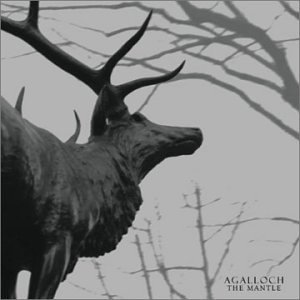
THE MANTLE (BY) AGALLOCH

Neofolk / Metal / Progressive / Soundscape
Released 2002

[For an explanation of Season Albums and Pivotal Albums, please go here.]

Agalloch is one of those bands that, if I bothered to organize and write out my Top 50 Albums of All Time, would so easily dominate the top of the list that the effort would seem to be pointless in the end.  They'd have two albums in the Top 10 and an EP in the Top 15 — it just wouldn't seem fair, though it would reflect how important (pivotal, if you will) their music has become to me. Agalloch is one of those bands — and I hope everyone has at least a few of their own — that is so perfectly tapped into what I desire and enjoy in music that their albums are literally flawless to me, every element so shockingly interesting and engaging with every listen that, no matter how many times I've heard it before, each time I'm surprised to find just how much I like them.

Despite forming over a decade ago, Agalloch's blend of dark atmospheric folk, post-rock soundscapes and black metal gravitas has proven too intricate and complex to spawn any successful imitators.  Those who try seem to capture no more than one or two elements of Agalloch's sound, dividing it up until the result is meaningless, or silly.  On paper, Agalloch doesn't seem all that far removed from the many gimmicky "folk metal" bands out there, but Agalloch isn't interested in simply re-appropriating some traditional musical style — despite my usage of the genre term "folk."  What they're playing sounds folky, but the actual elements are not stolen specifically from anywhere.  There are some unique pieces of instrumentation, sure, but you almost don't notice them, and they're certainly not the focus.  In "The Lodge", for instance, Agalloch creates a surreal echo by striking a deer skull — but you would never realize what you were hearing unless you read it somewhere.  Other songs feature the deep, creepy menace of a cello, or sound clips of footsteps crunching snow, but the songs are driven by simple, standard instrumentation, written in such a way as to evoke a cold winter landscape and carried to perfection by the harsh, dual-vocals and lyrical paganism.

Perhaps the problem of capturing Agalloch's success (or even getting Pandora to recommend anything remotely similar) lies in the term "folk".  Not only has it been around forever (literally), it's currently one of the most re-interpreted and re-imagined genres out there, other than metal.  There's a reason why folk music is forced to embrace every bearded, flannel wearing dude who just wants to strum his acoustic and recite poetry in a breathy voice — well, other than the fact that "I want to have sex with the largest possible number of girls with the least amount of effort" is too long to catch on as a genre term.  Folk has always been around because it is traditional music, which is by necessity always in flux, played by "the people," so to speak.  Traditional instruments can be a part of it, but "folk" literally means "people," and thus singer-songwriters are always sort-of folk regardless of their actual musical orientation.  Thus, for all its vagueyness and ability to transform into confusing other things, folk is a terrible term when you're trying to denote an incredibly specific sound — as anyone who wishes to describe Agalloch's music certainly is.  I'd argue that there should, in fact, be an invented genre term so bands who actually evoke the feeling of being in nature can distinguish themselves — I've heard the term "soundscape" used before, though seldomly, and I'd argue that it's a far more accurate indicator than just another "folk" subbranch with a silly name.

Since this is not a review, I'm not going to spend much time analyzing the actual music of The Mantle.  It's complex in a shifting, understated way, though deceptively straightforward in execution, and as is the case with pretty much every band I editorialize on here, I feel like I would spend the majority of my words just defending the fact that cross-genre hybrids can work without feeling cluttered and disjointed.  There's a clear trend in what I enjoy: textured, layered music that doesn't just borrow from one genre, and even after combining its elements together into a coherent sound, doesn't fit easily into another.  Songs on The Mantle are long and patiently crafted, unhurried and expansive, pagan, cold, eerie; they make you feel like you're stranded in a lodge in the middle of the woods, in winter. The vocals — the most metal aspect of the band — are likely difficult for new listeners, but match the cold textures and dynamics of Agalloch's songwriting, both harsh and clean vocals soon blending into the layered sounds surrounding them.  If you listen to The Mantle in summer, it will still sound like winter (Agalloch has another album for summer).  If you listen to it driving through the Catskills in a fancy SUV, you will still feel desolate and trapped and cold.  Though it's never particularly heavy, fast-paced or intimidating in the way that most metal is, this is a brutal album as much as it is a beautiful album.  The Mantle isn't made to be played at festivals or Burning Man; it isn't a commentary on the fastidiousness or overproduction of modern music; it isn't a reproduction of the bloody good old days of European battle-songs and beer-filled taverns; it has nothing at all to do with people — it is the outdoors, and the influence is inescapable.

Saturday, February 6, 2010

PIVOTAL ALBUMS & SEASONAL MUSIC: AN EXPLANATION

In an effort to give myself the opportunity to write about music more often, I'm "launching" a new "feature" on The Luxury Yacht Review.  I never review new albums outright on here, for a variety of reasons that I won't get into, but I would like to discuss music, as it's of equal importance as books to me — and so, I will post editorials instead of reviews, focusing on pivotal albums in my collection, albums that are significant with regards to how I listen to music.  The first of these two overlapping features, Seasonal Albums, is meant to discuss albums that highlight how I listen to music.  Certain albums, regardless of when I discovered them, create extremely vivid soundscapes for me, transporting me to a time or place or often conjuring a whole season.  Many albums with this power have greatly affected my mindset and preferences for music, and their evocative power makes them far more than just "entertainment" to me.

These seasonal albums will, for obvious reasons, often overlap with my second, also loosely structured feature — a sort of unranked Top 50 Albums of All Time deal, generalized here as Pivotal Albums.  Instead of actually making such a list and stressing about its order, by posting editorials at random, I can feature albums that likely would place without having to pit them against one another.  These albums will provide a window into my constantly-shifting musical tastes, as they are the albums which have determined that taste and then weathered my peculiar, inscrutable whims.  They may yet fall or rise in my favor with time, but these are the albums which will continue to influence me until I turn into a crotchety old man who only listens to Led Zeppelin while sitting on his porch drinking beer.

Wednesday, January 6, 2010

TOP X ALBUMS OF MMIX: I

I. Sol Eye Sea i (by) Irepress
Progressive/ Psychedelic / Metal / Hardcore / Electronica

Without even getting into the first impression left by the purpley madness on the cover, it's hard to know what to expect going into Sol Eye Sea i.  And after listening, it's hard not to become defensive when spreading the good word — successfully describing to anyone else what you heard is going to be as easy as convincing them you just saw Sasquatch.  Any album as chimerical as Sol Eye Sea, by all logic, should be a mess — and maybe it is a little messy, but damn does it work.

When bands attempt to mix divergent styles together, it can usually go one of several ways.  There are "generic style + additional instrument" bands (folk metal, chamber pop), or bands which write individually unique songs, almost like they're composing a mixtape (Gorillaz, etc.). The danger is always that nothing syncs on a compositional level, and Irepress wisely fuses their influences into a cohesive sound that permeates everything from their selection of tones to the background guitar filler. At various moments on Sol Eye Sea, you'll find these guys re-imagining and re-appropriating prog-rock, post-hardcore, trip-hop, electronica, post-rock and something I'm going to call "Eastern math-sludge metal", sprinkled with handclaps, group-chant vocals, howled screams and nonsensical phonetics, haunting strings, piano, glitch, and a guitar that sounds like a bagpipe.  Oh yes — and soundclips from The Goonies remixed breakbeat style.

I'll try to explain why all this works so well, but I want to note that obviously many people aren't going to agree with me. By virtue of its uniqueness, some listeners will find Sol Eye Sea strange and indigestible.  But to suggest that this is quantity over quality, or some such glib dismissal, would be a gross misunderstanding of what Irepress is doing. The album works because the many style-shifts and quirks aren't simply staggered one after the other; this is a band whose every chord progression and interlude is rich with identity. Even so, style can only get an artist so far. Many critically acclaimed experimental acts — particularly those that incorporate electronic elements — leave me feeling cold emotionally, distant from the music and bored. Take indie-darlings Battles, a band that treads superficially kind-of similar territory as Irepress.  The members of Battles certainly possess musical chops, throwing together so many disparate technical tricks that every hip music blog seems to adore them. But the end result strikes me as only superficially "interesting" music. It's the same problem that a lot of prog-[whatever] faces: each element is there just to be there, and taken apart, each is boring on its own, innovative only so far as its proximity to all those other cute little tricks and odd time signatures. No element of the music is unique to the band; nothing defines their sound. 

Irepress, on the other hand, could never be mistaken for anything else but Irepress, and anyway, they're far too earnest to be hip and too fun to be pretentious. They understand that they need to take their time with their creativity, to pace themselves, and it's a large part of the album's success. There's certainly a lot going on, but importantly, never too much at once.  The tones and effects successfully navigate the fine line between "unique" and "tacky" — whereas the latter would amount to no more than sounds chosen for their strangeness, everything here relates to everything else, making each unexpected turn a textured revelation of tone instead of just a quirky "hey, let's add a theremin!" moment.  In other words, the music is coherent enough to work instead of gimmicky enough to distract you from the fact that it doesn't.

There is space on Sol Eye Sea, and a lot of it — even the first listen gives an impression of an experience. Instead of rushing at you headfirst and pummeling you into attention, Irepress makes music that moves with the flow of some half-crazed mosh-pit breakdown — picture those heavy, deliberate steps, swaying arms, the unpredictable energy, the sudden surge of momentum, the boot that comes out of nowhere and knocks you on your ass. When you look back up, no one seems to be moving very fast, they're just doing their little dance, but things could turn raucous at any moment.  If I really had to get specific, describing Sol Eye Sea?  It's like getting into a Drunken Master style mosh-pit throwdown with Buckethead at a Buddhist-themed discotheque... in space.  You know how there are bands where you can listen to a split-second splash of sound and immediately say "Oh, that's David Gilmour, innit."  Irepress is like that. Dancing mixed with metal? Breakdowns composed as segments of a movement instead of gimmicky transitions? Progressive music that's so fun and engaging you feel like you're on drugs, instead of just assuming the musicians were? They pull it off. This is truly 2009's classic, at least within my collection — and since Irepress aren't likely to spawn many imitators, they will likely remain one of the most original and inventive bands in music today.

Tuesday, January 5, 2010

TOP X ALBUMS OF MMIX: II

II. Daisy (by) Brand New
Indie / Post-Hardcore / Noise-Rock

Brand New releases an album. The majority of critics give it fantastic reviews. The majority of Brand New fans hear the album, realize it sounds nothing like their last album and immediately hate it. Half of Brand New's fans bail. Well, they're not a band for casual listeners, and this music is anything but: dense and schizophrenic, listening to Daisy is meant to be an unsettling experience. The band has claimed they'd rather make an album that 50% of people hate and 50% of people love than album that everyone kind-of likes, and that's exactly what you have here.

Brand New's lyrical themes have always come together with a clash of contrasts, balancing the narcissism of youth with frontman Jesse Lacey's obsession with death. Songs often seemed to capture a particular sort of violent, spontaneous human interaction, even if heavily buried in metaphor. After a few spins of Daisy, it seems inevitable in hindsight that their sound would shift toward such dynamics as well. Brand New have become full-on composers of noise, dissonance and bizarre inversions. Rather than writing hooks, the band teases twisted squeals and frenetic shredding out of their instruments, savoring every strange tone. Backing guitars sometimes provide rhythm—and sometimes rumble forward in the mix with a sound like a chainsaw revving. This, in the end, is why Daisy works so well: when Brand New does something, they do it well, and I've heard few other bands that are able to use background instrumentation to such unique effect, or craft unorthodox dissonance with such personality.

Daisy is perfectly produced to capture the whole unsettling unfair, and the compositions are so detailed and well-constructed as to make the madness accessible. It was always atmosphere that drew me to Brand New, after all—a sense of mood and tone that their contemporaries lacked before and utterly abandoned by now. Thanks to a clanky, textured tone and aggressive presence in the mix, the bass guitar ends up being one of the most interesting elements on the album. But all instruments serve two roles—you'll also find that same bass doing epically fuzzy slides through the chorus of "You Stole", creating an effect that sounds not-unlike a whale giving birth. It's but one aspect of the tense unpredictable energy that carries the album. Many reviewers and detractors have made comparisons to The Jesus Lizard (or Modest Mouse) and Nirvana. While Brand New has always admitted inspiration from these (and many other) bands, the differences remain stark: where the previous bands chug away at songs with raucously loose, drunken energy—creating the dynamic instability which evokes these comparisons—Daisy is both more conscious of its unbalanced style and unhinged in its execution, creating more forceful guitar delivery, far tighter song structures and a more textured take on "noise rock" aesthetics.

That a band is able to adapt their style so casually while still retaining the sensibilities that make each album recognizably Brand New is no small accomplishment—but each album has to be good on its own, for its own merits, and Daisy succeeds against all odds (and in spite of its flaws, which are certainly there). It isn't a perfectly executed album, nor a contender for their best, but I found myself listening to Daisy more than any other album in 2009. Brand New is clearly a little bit crazy—enough to piss off the people who buy their albums and thereby ensure that they keep putting out good ones.

Monday, January 4, 2010

TOP X ALBUMS OF MMIX: III

III. From Fathoms (by) Gifts From Enola
Post-Rock / Shoegaze / Post-Hardcore

Gifts From Enola's approach to an over-crowded genre is as subtle as it is interesting. A casual listener might dismiss them as "yet another post-rock band," but that would be a mere knee-jerk response, and a terrible mistake. GFE is another post-rock band, but they're deceptively clever about it. I was bored with most of 2009's post-rock contenders, even many albums from skilled old hands. From Fathoms contains no fancy gimmicks to set it apart, no orchestra or tap-dancing or Egyptian-themed lyrics with 4000 year old chord-progressions. There are hints of electronica, a few sound clips here and there and casually-dispersed vocals. But for the most part, this is upfront no-bullshit post-rock. With emphasis on the rock.

Gifts From Enola's main asset is their directness. Led by clean-toned guitars that explode into the mix, songs wash over you with astonishing freshness, wave upon wave of thick solid riffs. That, I think, is the greatest compliment I can give this album, especially considering its genre: more than half a year after it came out, From Fathoms still sounds incredibly fresh each of the many times I listen to it. There is so much energy here, so much enthusiasm and vigor for their music, GFE washes away all the rote, timid post-rock conventions, the epic build-ups and simmering, stewing guitar haze. Sure, there's reverb and delay and crescendos, and song-structures often lead to a pretty epic conclusion, but they do so much more than that along the way. Too many post-rock bands have discovered that a few choice guitar chords and ponderous effects will evoke certain basic emotions, and they dwell upon this, plucking away at melancholy as if it were a result and not a feeling. From Fathoms deconstructs the formula and reassembles it as something new and interesting. Songs are thick and fluid—if Do Make Say Think creates tidal music, GFE has created oceanic music, a background of beautiful storms led by a refreshingly earnest, unpretentious crash of guitars. Song structures don't follow any particular conventions, simply going where they wish, building up and knocking down, often thicker and deeper than you can see through—a major part of the album's freshness and energy. When they want to drop you into a bit of shoegazey indie rock with light vocals, they make sure you notice, they don't waste space with meaningless interludes. When screams come in and then fade out, there's suddenly space, an open sky and a sense of place, a beautiful Alcest-ian acoustic passage to move you forward into the next storm. From Fathoms is often heavy but never sludgey, and so the music seems to drench you, tugging and pushing and tossing you around instead of simply burying you in the mud.

Few bands can pull off the transition from light to dark or beautiful to catastrophic as sublimely as GFE. It's no coincidence that so much of this album mirrors a trip out to sea, and From Fathoms could easily be considered a concept album of sorts, ruthlessly shredding your ship with the colossal "Trieste," stuffing your head in the sink for a while before ending in a trio of surprisingly uplifting, heavy-hitting jams. I have no real qualms with this album, but it should be noted that it is very much an "album"—songs are not meant to stand on their own, and to some (unimportant) extent, they don't. I cannot listen to From Fathoms without listening to the whole thing, a testament to GFE's ability to rush you forward without ever seeming forced or hurried about it. This album covers vast emotional ground (emotional water?), impressively pulling off both sorrow and optimism without ever being manipulative or dull.

Sunday, January 3, 2010

TOP X ALBUMS OF MMIX: TOP OF THE LIST

X. Eras (by) Apse
Psych Folk / Ambient / Indie Rock

Imagine that the apocalypse happened tomorrow and the only songs to survive were a few random albums by Radiohead and the Beta Band—random choices, mostly, but that's not important. Now, imagine you could travel 500 years into the future, where you stumbled upon a small society that absorbed and worshiped those albums generations ago, until they fell apart and the only music left was what that nascent society could reproduce and play on its own. If that little tribe somehow had electric guitars, this album is what pop music would sound like by then—filtered through primitive, earthy motifs, bouncy and tribal, colorful and creepy. Most of the surface-layer elements of mainstream rock are washed away, leaving a rough, beautifully textured underbelly. In many ways, Apse's music never feels complete—the vocals are buried in the mix, indistinct and ethereal, like hearing a group of people singing in the distance, hidden by forest. The drums are heavy and tribal, the basslines galloping forward with equal intensity, and the guitar on Eras often does little more than create atmosphere. Many will dismiss this album as half-formed and undeveloped, but if it seems empty, it is only because Eras so perfectly captures a time and place that doesn't quite exist—not yet.

IX. The Other Truths (by) Do Make Say Think
Post-Rock / Jazz Fusion / Folk

Do Make Say Think is one of the longest running post-rock bands in the world right now (that has consistently released albums during the last 10+ years) and so it's rather astonishing that The Other Truths, their sixth, sounds so entirely unlike anything else out there. DMST ignores most of the typical post-rock conventions: reverb and delay pedals aren't used much here, and crescendo-style song narratives are almost nonexistant. The music is tide-like, an aggressive ebb and flow of folky, full-bodied rhythms and jazz-style drums. Song structures go wherever DMST wants them to go, and the music within seems casual, almost lazy—not in the sense that the band isn't trying, but that they've reached a point where they have such command over their compositions that their songs spin airy circles around you with a minimum of effort. This is a band at their creative peak, and there's nothing passive about this music, nothing timid. It's intense, it's soft, it's Westerny, it's spacious, it's jazzy, it's friendly, it's going for a drive and you're along for the ride. With each of the four tracks an ode to the band's own name—Do, Make, Say, Think—one wonders if the members of DMST already realized that they just couldn't ever top a masterpiece like this.

VIII: Axe to Fall (by) Converge
Metal / Hardcore / Punk

Here's the secret to enjoying Converge: drink six cups of coffee first. Axe to Fall is nowhere close to accessible; it's dense and complicated and so aggressive that it's hard to figure out whether you're supposed to bang your head or cower on the floor in fear. But listen to the piece as a whole, let the purposeful pacing and layered intricacies unfold and maybe, maybe you'll be whisked away to the frantic, brutal landscape Converge skillfully paints. Equal parts technical metal showmanship and hardcore mayhem, Converge succeed as much through their delicious array of guitar-tones as by their amazing ability to give such blisteringly-fast songs so much personality. Their sense of tension and relief is masterful, and though the album weighs heavily on the side of tension, it only makes those releases all the more orgasmic. On the few songs where Converge slows things down and expands their sound, one begins to see how all that personality gets wrapped up in these brutal tunes. The Westerny monotone of "Cruel Bloom" is a direct nod to Tom Waits, but that whiskey-soaked, shadow-filled slum is hidden within everything here. Listening to Axe to Fall is like playing Whack-a-Mole... with rattlesnakes instead of moles and a six-string in place of a rubber mallet. Fuck yeah.

VII. Dyad 1909 / Found Songs (by) Ólafur Arnalds
Neo-Classical / Electronica / Ambient

Ólafur Arnalds released two stunning albums in 2009, and though it may be cheating to include both (or either, since neither is a true album in the strictest sense), this young Icelandic composer is just too talented not to be on my list. Dyad 1909 is easily my favorite of these two releases, though I felt it would be unfair to include it on its own. Compiled as the soundtrack for an experimental ballet of the same name, it contains three new songs, two old songs and one astonishing remix. Despite being part greatest-hits, the album is Arnald's most forward and heavy-hitting so far, overlaying booming electronica beats on top of his exquisitely minimalist violin and piano compositions. "Brotsjor" and "Til Enda" absolutely destroy, and since they're new, they're well worth the price of admission on their own. Like a glacier breaking apart and smearing you across the ice, Dyad is haunting, devastating, severe, desolate... and of course, heartrendingly beautiful. Lost Songs was a project conceived by Arnalds earlier in the year, in which he wrote, recorded and released a song every day straight for a week. The songs are short and focused, beautiful for all their simplicity, proving that Arnalds has a better mastery of space, atmosphere and emotional depth than perhaps any other composer working today.

VI. Sunden (by) The Waters Deep Here
Instrumental Metal / Post-Rock

This year's most random pick is also the album probably doomed to perpetual under-appreciation. Self-produced, self-released and almost totally unnoticed by anyone anywhere, Sunden didn't have me expecting much. And yet, in spite of the off-putting band name and barebones MySpace, this album's a total knockout. TWDH writes metal, and pretty straightforward metal at that. That's fine. Post-metal has been stale almost since the day it was born, and Isis-style sludge is getting extremely cliche by now. There may be only one guitar here, but the riffs are all over the place, tearing apart your face like a pack of rabid, unfed bears. The ass-kicking riffs never really stop coming, but instead of looping each or layering simple structures into a dense cloud of atmosphere, the guitarist bounces from one idea to the next, building a basic theme along the way. Songs wander into jazz-like labyrinths of rich, carefully-unfolding jams, meandering and smashing and crashing about without apparent direction before suddenly, satisfyingly hurling you back to the song's center. Though relatively straightforward and sometimes poorly-paced, Sunden proves that crushing, relentless metal can still contain plenty of flavor without resorting to scene cliches and rigid structural dogmas. The Waters Deep Here shows astonishing promise—now they just need to add an apostrophe to their name.

V. Hollow Be My Name (by) Eleventh He Reaches London
Post-Hardcore / Indie Rock / Progressive

Eleventh He Reaches London, like many bands on this list, knows how to combine disingenuous genres into a sound that flows from your speakers as a cohesive, tightly-composed musical personality. A concept album about 1800's Australian colonists who are pissed off at God and the Queen (or something), Hollow Be My Name presents something like a post-hardcore version of The Decemberists. The experimental mindset is there, but the songs are tight, focused and extremely forward, while intricate guitar work, unexpected tempo shifts and angry, rabble-rousing vocals keep the music from ever growing stale. That the album remains so fluid is merely a testament to the skill with which this Australian band composes. The clever, aggressive guitar-work carries most of the weight here, while the vocalist gives an equally incredible performance, showing as much versatility and energy as the rest of the band. Songs bounce along, perfectly paced and wonderfully detailed, unleashing just enough screamed rage, spoken-word growl and raw post-punk grit to make this far more interesting than mere rock'n'roll.

IV. Gin (by) Cobalt
Metal / Metal / Metal

With their third full-length release, two-man Cobalt has shifted the sound of their brooding pagan bonfire hymns from experimental black-metal to something more song-based but equally unorthodox. Gin is an homage to Ernest Hemmingway and Hunter S. Thompson, and the album certainly sounds like a drowned and dreary downward spiral to hell. Lyricist and vocalist Phil McSorley is a Sergeant in the US Army who served in Iraq, and the experience shows, even down to his voice, which rushes over the mix like wind bursting through a broken window. Cobalt has always struck me as one of the most sincere and yet disturbing metal bands out there, wasting little time on dick-wagging showmanship. Their heaviness never sounds like it's there just for the sake of being "metal," while their chilling ambiance, acoustic accompaniments and pulverizing guitarwork remain effortless. It should be noted that genius multi-instrumentalist Eric Wunder plays and/or writes—from what I understand—almost everything but the lyrics, and brings a coherency and energy that few five person bands can match, sculpting a sound that's both straightforward and yet crushingly morose. Every glimpse into pagan darkness makes Cobalt's music no less infectious—these men know how to write an absorbing, haunting song.

Related Posts-