Showing posts with label Pivotal Albums. Show all posts

Sunday, June 20, 2010

BLUE RECORD (BY) BARONESS

Progressive Sludge Metal / Southern Rock
Released 2009

When I put together my Top 10 Albums of 2009 list at the end of last year, I spent weeks scouring blogs and forums and online review sites looking for any albums I might have missed.  But even with all my intended thoroughness, I still made one glaring error.  The Blue Record got a lot of press after its October release, and ended up on many "best of the 2009" metal lists, often finishing in the top 3.  So I downloaded it, listened to it, and decided it was worth keeping around, but it didn't grab me right away.  Every now and then I gave it another spin, until eventually, only a week or two after I published my own Top 10, I suddenly found myself playing the Blue Record more and more and more.  By early January I was listening to almost nothing else.  It's an album that's perfect for any mood or occasion, that I can always throw on after work and find myself caught up in its infectious energy no matter how dull or shitty my day has been.  The Blue Record deserves to be spun all summer long, but it got me through an entire winter.  It's one of the few albums that stands as entertainment of its own right, a soundtrack to 45 minutes of spastic air-drumming.

The thing is, I can pinpoint exactly why Baroness didn't grab me at first.  They're from the elite Georgian school of sludge metal, the same state that's also somehow brought us Mastodon, Torche and Kylesa.  I like all these bands well enough, except for one thing: their vocals.  If you've heard any of them, you know what I'm talking about, because their vocals are all pretty much the same, down to the rhythm and structure.  Each verse is pretty much delivered like this: shout shout shout / shout shout YELLLLLLL.  It's simple and repetitive, and the "drunken bearded man shouting at a bar" vibe always really turned me off.  A lot of metal has this problem, from Isis-derived post-metal to stoner metal and back to sludge.  Not that metal vocals are inherently bothersome, of course — the ones that work, work really goddam well — but that metal listeners tend to be unnecessarily forgiving of genuinely bad vocals.  As much as I respect all of the above bands, I could only take them in small doses because of their vocals. 

Baroness was no different, but I sensed that the music underneath was within my tastes, moreso than their more traditional peers.  For one thing, Baroness isn't nearly as classically sludgey as, say, Mastodon was with their first few releases, nor nearly as wanky-prog-metal-y as Mastodon became with their latest effort.  There's an unmistakable southern vibe to the music, down to the folky acoustic interlude "Blackpowder Orchard" and it wonderfully compliments Baroness' unrelenting, upbeat energy — like a cross between Led Zeppelin and the Melvins with the record player set at 45 rpm instead of 33.  Instead of wasting all their time trying to find the [fucking] heaviest [fucking] guitar tone ever [dudeeee] Baroness sends nearly every song galloping out of the gate with a stampede of drums and riffs so blazing, you may find yourself spontaneously air-guitaring on a crowded subway platform.  [Not that I've experienced this myself. I've... read about it.]  Instead of morphing into some prog-metal, seizure-inducing bonanza, Baroness keeps every song tight and perfectly coordinated, each filled with a ton of texture, little tangents and details and experiments enough to still earn it the "progressive" label, but these elements are always secondary to the pacing of the song, instead of being responsible for it.  Baroness never meanders enough to get distracted.  Songs move fast, almost too fast to keep track of.  The drums are unrelentingly propulsive, like this album is being shot at you out of a cannon.  Yet it's fun.  It's coherent.  It's never boring, it never loses focus, because these guys have their style down to an art.  Baroness doesn't have to be the heaviest band on the scene when the Blue Record contains some of the tightest song-writing you'll ever find south of the Mason-Dixon line.

So after a few listens, something strange happened: I grew to not mind those vocals.  Then, inevitably, I guess I liked them.  Now I can't imagine the Blue Record without them — shouty and rough and incredibly repetitive though they may be, no other style would really fit the energy and intensity of Baroness' music, and I dare say they work much better here than over the slow, heavy march of other sludge bands.  The Blue Record is pretty intense, and dense as well, yet even at its most technical it never loses sight of being fun.  (And there's nothing wrong with metal being fun).  This is an album I want blasting from my porch all summer long.  This is that album that makes me want to own a car again, badly, just so I can rock out to it while tearing down the highway with the windows down.  This album will give you whiplash.

Sunday, March 14, 2010

THE FIRE IN OUR THROATS WILL BECKON THE THAW (BY) PELICAN

Post-Metal / Sludge / Atmospheric
Released 2005

I was recently having a discussion with some peers about which albums most influenced our lives — albums that have not only stuck with us, but after first discovering them, drastically affected what music we listen to and how we listen to it.  I can pinpoint many albums that were, in retrospect, important to my current tastes, but most of them were simple progressions of things I was already listening to, another evolutionary link.  Other albums got me into new habits — my flirtations with metal were spread out over multiple years and many extremely different albums — but didn't themselves make a lasting impression, and in retrospect only presented a few easily-digested morsels that encouraged me to pursue new things, new tastes.

When a friend introduced me to The Fire In Our Throats Will Beckon the Thaw in the spring of my junior year of college, the timing couldn't have been more perfect.  For a few months, I had been seeking out experimental, heavy music. I already had a hunch then that I would never be a real metal-head, but I liked a lot of the things metal bands were doing, even if I was having a hard time getting past the often-difficult vocals.  Though I'd been occasionally listening to Godspeed You! Black Emperor since high school, I didn't really have awareness of instrumental music at that point.  GY!BE still seemed to me like a soundtrack lacking a movie, and like most people, I didn't understand why a band would decide to remain instrumental.  So Pelican came out of nowhere — I had truly never heard anything like it before.

Now, kids these days can easily describe entire subgenres of instrumental metal by the degree to which they rip off of Pelican (and other forebears of the post-metal movement), but hearing such a thing for the first time, or describing it to someone else, is like trying to explain to a blind man what "green" looks like.  I remember once telling my father that Pelican reminded me of Pink Floyd — a comparison that's so laughably erroneous four years later, I haven't the slightest idea what I might I have been referring to.  The Fire In Our Throats is, for lack of a better word, glacial — not usually a word I'd use to describe music, but I can't think of anything else that fits so well.  It's cold and stark and huge, slow-moving and dense, but most importantly, it's a glacier in retreat, one leaving behind a vision of spring and growth and possibility.  There's a deep-rooted, earthy sense of beauty in Pelican's music, little touches of warmth and grace amidst all the thundering walls of riffage and distortion, not to mention their extremely unique, perfect executed acoustic transitions.  Amidst the calamity, The Fire In Our Throats evokes the sense that one has finally reached The Last Day of Winter (and whatdayaknow, that's the name of the first song!)  Within such an unsubtle musical style, it's an unexpected touch of subtlety that other bands trying to bogart Pelican's thunderous tone seem to completely miss.  A wall of sound becomes boring eventually — we want to be led somewhere, and sludge-metal is at best a way to move us.  Where many other post-rockers tend to paint a scene that's other-worldly, or post-worldly, The Fire In Our Throats is intensely familiar.  Rather than nostalgia, it evokes a sense of expectation.  It somehow makes the air around you feel fucking crisp.  If you listen to it in winter, you will feel striking disappointment when you step outside and see a gray, snow-filled sky.  Studies show playing it once a day will cause plants to grow 34% faster.  (It's science!)

One particular memory perfectly captures all the feelings that Pelican still evokes in me.  As I said before, the timing of my discovery couldn't have been more perfect.  It was spring.  Metal is generally considered depressive stuff, but Pelican is anything but.  That winter had been a particularly difficult time of my life, and it's no exaggeration to say that I felt totally buried in frustrations and anxieties.  Timid music wasn't going to do anything to move me, but The Fire In Our Throats is as uplifting and inspiring as it is loud.  Like spring, there's a sense that mounds of filth are being washed away — forcefully, cathartically, and jarringly.  I needed that, then, and so I took a walk on the first day of spring, past all the sun-tanning sorority girls and shirtless jock douchemonkeys, and went down to the Hudson.  It felt good to get off campus and out of sight.  I found a spot above a cliff and watched car-sized chunks of ice floating down the river, I stared at the mountains that surrounded me, and I realized just how fucking much I loved the Hudson River Valley — everything except that small vortex of suck that was Poughkeepsie.  I could feel the cold whenever the breeze picked up, but it was still warm enough to wear a t-shirt.  And somehow, Pelican was playing exactly what I was feeling and seeing — without words.  I had never experienced that from music before. Suddenly I was getting punched in the face by a sort of frontiersman's spirit, awed by the severity of nature and music with the ability to capture it as textures and sounds.  I felt, dare I say, inspired.

So, Pelican got me into instrumental music, heavy music, and oddly enough, hiking.  (Cool story, bro).  The sense of gravitas and yearning their music evokes has never worn off, and I always feel an urge to put it on when I venture out to Upstate New York.  Sadly, their last two releases have been solidly mediocre, and their sound has since been regurgitated by dozens of bands, bottled and packaged as a tepid subgenre.  It's obvious in retrospect that Pelican's strengths also demand a rather inflexible formula, and after creating such a perfectly-executed landmark album, they'd basically written themselves into a corner.  (I should note that their first album, Australasia, is nearly on par with The Fire In Our Throats, yet presents a markedly different atmosphere).  The Fire In Our Throats still stands as one of the most evocative and emotional albums in my collection, a testament to the (seldom-realized) fact that beautiful music doesn't have to be timid or cloying.

Tuesday, February 9, 2010

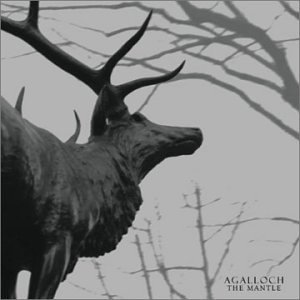
THE MANTLE (BY) AGALLOCH

Neofolk / Metal / Progressive / Soundscape
Released 2002

[For an explanation of Season Albums and Pivotal Albums, please go here.]

Agalloch is one of those bands that, if I bothered to organize and write out my Top 50 Albums of All Time, would so easily dominate the top of the list that the effort would seem to be pointless in the end.  They'd have two albums in the Top 10 and an EP in the Top 15 — it just wouldn't seem fair, though it would reflect how important (pivotal, if you will) their music has become to me. Agalloch is one of those bands — and I hope everyone has at least a few of their own — that is so perfectly tapped into what I desire and enjoy in music that their albums are literally flawless to me, every element so shockingly interesting and engaging with every listen that, no matter how many times I've heard it before, each time I'm surprised to find just how much I like them.

Despite forming over a decade ago, Agalloch's blend of dark atmospheric folk, post-rock soundscapes and black metal gravitas has proven too intricate and complex to spawn any successful imitators.  Those who try seem to capture no more than one or two elements of Agalloch's sound, dividing it up until the result is meaningless, or silly.  On paper, Agalloch doesn't seem all that far removed from the many gimmicky "folk metal" bands out there, but Agalloch isn't interested in simply re-appropriating some traditional musical style — despite my usage of the genre term "folk."  What they're playing sounds folky, but the actual elements are not stolen specifically from anywhere.  There are some unique pieces of instrumentation, sure, but you almost don't notice them, and they're certainly not the focus.  In "The Lodge", for instance, Agalloch creates a surreal echo by striking a deer skull — but you would never realize what you were hearing unless you read it somewhere.  Other songs feature the deep, creepy menace of a cello, or sound clips of footsteps crunching snow, but the songs are driven by simple, standard instrumentation, written in such a way as to evoke a cold winter landscape and carried to perfection by the harsh, dual-vocals and lyrical paganism.

Perhaps the problem of capturing Agalloch's success (or even getting Pandora to recommend anything remotely similar) lies in the term "folk".  Not only has it been around forever (literally), it's currently one of the most re-interpreted and re-imagined genres out there, other than metal.  There's a reason why folk music is forced to embrace every bearded, flannel wearing dude who just wants to strum his acoustic and recite poetry in a breathy voice — well, other than the fact that "I want to have sex with the largest possible number of girls with the least amount of effort" is too long to catch on as a genre term.  Folk has always been around because it is traditional music, which is by necessity always in flux, played by "the people," so to speak.  Traditional instruments can be a part of it, but "folk" literally means "people," and thus singer-songwriters are always sort-of folk regardless of their actual musical orientation.  Thus, for all its vagueyness and ability to transform into confusing other things, folk is a terrible term when you're trying to denote an incredibly specific sound — as anyone who wishes to describe Agalloch's music certainly is.  I'd argue that there should, in fact, be an invented genre term so bands who actually evoke the feeling of being in nature can distinguish themselves — I've heard the term "soundscape" used before, though seldomly, and I'd argue that it's a far more accurate indicator than just another "folk" subbranch with a silly name.

Since this is not a review, I'm not going to spend much time analyzing the actual music of The Mantle.  It's complex in a shifting, understated way, though deceptively straightforward in execution, and as is the case with pretty much every band I editorialize on here, I feel like I would spend the majority of my words just defending the fact that cross-genre hybrids can work without feeling cluttered and disjointed.  There's a clear trend in what I enjoy: textured, layered music that doesn't just borrow from one genre, and even after combining its elements together into a coherent sound, doesn't fit easily into another.  Songs on The Mantle are long and patiently crafted, unhurried and expansive, pagan, cold, eerie; they make you feel like you're stranded in a lodge in the middle of the woods, in winter. The vocals — the most metal aspect of the band — are likely difficult for new listeners, but match the cold textures and dynamics of Agalloch's songwriting, both harsh and clean vocals soon blending into the layered sounds surrounding them.  If you listen to The Mantle in summer, it will still sound like winter (Agalloch has another album for summer).  If you listen to it driving through the Catskills in a fancy SUV, you will still feel desolate and trapped and cold.  Though it's never particularly heavy, fast-paced or intimidating in the way that most metal is, this is a brutal album as much as it is a beautiful album.  The Mantle isn't made to be played at festivals or Burning Man; it isn't a commentary on the fastidiousness or overproduction of modern music; it isn't a reproduction of the bloody good old days of European battle-songs and beer-filled taverns; it has nothing at all to do with people — it is the outdoors, and the influence is inescapable.

Saturday, February 6, 2010

PIVOTAL ALBUMS & SEASONAL MUSIC: AN EXPLANATION

In an effort to give myself the opportunity to write about music more often, I'm "launching" a new "feature" on The Luxury Yacht Review.  I never review new albums outright on here, for a variety of reasons that I won't get into, but I would like to discuss music, as it's of equal importance as books to me — and so, I will post editorials instead of reviews, focusing on pivotal albums in my collection, albums that are significant with regards to how I listen to music.  The first of these two overlapping features, Seasonal Albums, is meant to discuss albums that highlight how I listen to music.  Certain albums, regardless of when I discovered them, create extremely vivid soundscapes for me, transporting me to a time or place or often conjuring a whole season.  Many albums with this power have greatly affected my mindset and preferences for music, and their evocative power makes them far more than just "entertainment" to me.

These seasonal albums will, for obvious reasons, often overlap with my second, also loosely structured feature — a sort of unranked Top 50 Albums of All Time deal, generalized here as Pivotal Albums.  Instead of actually making such a list and stressing about its order, by posting editorials at random, I can feature albums that likely would place without having to pit them against one another.  These albums will provide a window into my constantly-shifting musical tastes, as they are the albums which have determined that taste and then weathered my peculiar, inscrutable whims.  They may yet fall or rise in my favor with time, but these are the albums which will continue to influence me until I turn into a crotchety old man who only listens to Led Zeppelin while sitting on his porch drinking beer.

Related Posts-