Showing posts with label Disappointment. Show all posts

Wednesday, November 10, 2010

I WAS TOLD THERE'D BE CAKE (BY) SLOANE CROSLEY

Published 2008, 228 pages
Characters: N/A
Writing: C+
Plot: C
Pacing: C+
Poignancy: C

In my recent review of The Thieves of Manhattan, I complained that maybe humor books just aren't for me anymore.  While my lament was certainly relevant to that novel, it was equally inspired by I Was Told There'd Be Cake, which I had started previously and, after struggling through a few stories, put down in frustration.  I almost never picked the book back up, knowing there was little chance I would like it.  But I have a blog, and therefore a mission, and thus an obligation, dammit.  The book had to be reviewed.  And guess what?  I did not enjoy it.  I Was Told There'd Be Cake is a collection of "humor" essays — modern confessional essays in the vein of David Sedaris, focusing on the wacky things that happen in the author's life and her self-deprecating reactions to said wacky things.  It's probably unfair to compare everything in this genre back to Sedaris, just like every other review of I Was Told There'd Be Cake does, but whatever — Cake is essentially a watered-down version of Sedaris without any of the insight or humor.

Ultimately, anyway, humor can't really be analyzed, since it's mostly subjective.  Nonetheless, I'm perplexed as to what in this book was meant to be funny at all.  I hate to be so cruel, but this collection reads like an assortment of LiveJournal entries that some college senior shipped off to a publisher.  It's choppy, banal and never says anything interesting or insightful.  Sure, any slice-of-life story can be funny if told the right way, with a strong voice, and Crosley doesn't go for cheap shocks or obvious hyperbole.  It's undoubtedly grounded in reality, no question.  But that's just the problem.  These are the sort of stories you tell your own friends, while wasted, to maybe get a few chuckles.  The sort of stories you write while pissed-off over the day's events and later read to your writing workshop so you can vent — and maybe get a few sympathetic smiles.  Crosley establishes herself as an average person from a wealthy suburban background, who's never had to work all that hard, who's suffered the same mild embarrassments and set-backs that everyone has suffered, but still manages to find time to condescend to those around her.  She's had bosses that were mildly irritating, and yelled at her — but don't worry, she found a new job the day after she quit anyway, the day after 9/11 no less!  What luck!  She's self-deprecating, in an attempt to make herself seem even more average, but self deprecation is an art that she can't quite pull off, and instead it just makes her sound self-absorbed. 

I don't want this review to sound like a character critique when it's a review of a book, but such things are hard to get past when dealing with confessional essays — the writer's personality often is the story. The main problem with Cake, and my primary confusion with how Crosley got this published in the first place, is that Crosley is just not a very good storyteller.  Her tone is generic and predictable; her every-day subject matter is never elevated to anything else.  She's not witty; she just sounds exasperated.  Her narratives jump around clumsily and rarely have anything like a satisfying resolution.  Some of the stories here are strangely hard to follow for lightweight humor essays, and others end so abruptly and pointlessly that I began checking my copy for missing pages.  Without humor, without poignancy, without gripping storytelling or well-crafted prose, there's simply nothing here.

Thursday, August 19, 2010

BLOOD MERIDIAN (BY) CORMAC MCCARTHY

Published 1985, 335 Pages
Characters: C+
Writing: A
Plot: D
Pacing: D
Poignancy: B

Reading Blood Meridian isn't so much like reading a traditional novel as watching hours worth of old historical footage spliced together with no narration.  Set around the US / Mexico border in the 1850's, during a series of violent raids and military skirmishes, there is never enough focus or plot to seem like, well, a novel.  Like those old sepia-tinted movies, it's all wide-shots, jumpy unclear footage, sudden cuts from one scene to the next.  You can tell you're following the same group of characters, but the camera rarely ventures close enough to learn anything about them, and most of the time all you see is one big mass moving about the screen.  And like watching three hours of historical footage, it becomes increasingly tedious and disorienting the longer you stick with it — even if the scenery is nice and individual scenes, taken on their own, seem interesting enough at first.

Blood Meridian was probably one of the most difficult books I've ever tackled.  It is a novel, technically, but the actual experience is more akin to reading a 300 page prose poem about gratuitous violence and desert landscapes, written in a sort-of stylized Biblical language.  Blood Meridian follows a group of Americans wandering throughout Mexico, stopping at a dozen towns that all start to sound the same, fending off wildlife, Indians, angry Mexicans and ultimately killing lots and lots of people.  That's it: there's no overall plot, no sense of momentum or purpose or change.  Every chapter feels the same as the last, but with a few details changed.  The group wanders, kills, rides, fights, kills.  Characters join the group and soon leave, rarely staying long enough to be given a name.  Without a plot, the book is disorienting enough as it is, but Blood Meridian lacks even a main character to center itself around — and this, ultimately, prevented me from every really becoming immersed in the story.  Some summaries and reviews will try to tell you that "The Kid" is the protagonist of Blood Meridian, but that's bullshit.  For the first 50 or so pages, The Kid is the driving force of the story, which at least seems like it's going somewhere in the early stages.  Blood Meridian would have made for a fantastic novella, as it could have made its point without repeating itself over and over.  But after the first few scenes, The Kid quickly fades from the picture, never amounting to more than a passive participant, just another member of the group.  McCarthy goes for entire chapters without mentioning him at all.  Open up Blood Meridian to a random page in the middle and the most common pronoun you will see is "they."  "They" are the main character of the novel. If you wanted to be really flippant, you could boil the plot of Blood Meridian down to McCarthy's favorite pronoun + verb combo: "They rode...."

It's hard to review Blood Meridian for its various merits, as they are ultimately so lopsided.  McCarthy clearly had a very specific goal in mind when he wrote the book, and its "thesis" is interesting enough: this is an anti-Western, an exploration of the endless cycles of violence that actually made up the Old West, rather than heroics and clear-cut gun duels.  But as with performance art, your reaction will likely depend on how far you believe a 'statement' can sustain art.  Is the mere statement or idea enough, without anything developing overtop of it?  Blood Meridian is not a particularly deep book; maybe my attention-span was just so shot that I didn't notice its layers, but it seemed pretty one-note to me.  They ride, they kill, people die.  Violence is bad but unlikely to change, see?  Do we need 300 pages of interchangeably gruesome events to make this point?  Or at least, why couldn't McCarthy make this point while still crafting a plot? 

This is a debate that I will likely end up on the losing side of, but it's nonetheless a huge beef that I have with the literary world today.  There seems to be an unquestioned bias among literary readers that well-written prose is the primary goal of a story — and that plot, being on the other end of the spectrum, is not only cursory but even unnecessary.  McCarthy seems to agree with this philosophy.  I can't in fairness say that the plot of Blood Meridian is "bad" because he literally made no attempt to craft one.  But why is this excusable, much less preferable?  I should mention, if it's not too late, that Blood Meridian is considered not only the best of McCarthy's books but one of the best works of literature in the last half century by many smart people.  Now, I can understand why some would enjoy it — the writing is absolutely fantastic on a technical level — but really, a landmark of contemporary literature?  Frankly, I don't see why McCarthy's difficulty with plot is any more excusable than Dan Brown's inability to not write like a 5th grader.  Sure, Brown is a truly awful writer, on a technical level, while McCarthy excels at this.  But McCarthy cannot write plot, and Brown — for all his many flaws — knows how to shape a riveting story.  My opinion of Brown as a writer is very low, believe me, but I'm merely trying to illustrate a point — why is there such favoritism for the various elements of a novel?  Why is plot not considered important to a book's worth, when it's so crucial to the actual process of reading for many people?  I found many sentences in Blood Meridian to be utterly stunning; some so well-written that I literally went wide-eyed.  Yet even so, the book remained a chore to work through, and when I would sit down with it again, I was frequently unable to tell whether I had read a certain scene already or not, as they all end up sounding so similar.  There's nothing more frustrating than that sudden, bitter feeling that there may be no point in actually reading a book to its end.  As someone who enjoys the "story" aspect of "stories," a clear, strong narrative would have allowed me to enjoy Blood Meridian as more than a long string of beautiful words.  No matter how beautiful the scenery, no matter how vast and striking the landscape, if there's no path to give you a sense of direction, you're eventually going to get lost.

Saturday, June 12, 2010

SURVIVOR (BY) CHUCK PALAHNIUK

Published 2000, 289 Pages
Characters: C
Writing: C-
Plot: D
Pacing: B
Poignancy: C-

Chuck Palahnuik wants to write satire.  He wants to be a hybrid of Kurt Vonnegut, Don DeLillo and Napolean Dynamite.  He wants you to think that he's outrageous, shocking and insightful.  His efforts earn him blurbs on the back of his book like this: "A wild amphetamine ride through the vagaries of fame and the nature of belief in America at the close of the twentieth century."  Lots of people tell me how much they love Palahniuk, so he's doing something right, I guess. I hate sounding so negative in reviews for books that aren't, honestly, all that offensively bad or totally without merit, but Survivor is just not a well-constructed book.  It's a clusterfuck of plotting and characterization, it's aimless, cheap satire, and it tries so desperately to be shocking and clever and post-modern that it's nothing but contrived.  But it isn't a difficult read.  It's not painful, and it moves fast.  Even if you're as bored with it as I was, you'll have no problem finishing it.  If you're into Palahniuk, you'll probably enjoy it.  But as far as I'm concerned, Palahniuk's forte is finding a million clever ways to say nothing at all.

I blame his reputation largely on "Fight Club."  Don't get me wrong, "Fight Club" is a great story, and I consider the movie to be one of the better films of the last 20 years.  The book, too, is good.  If the movie had never been made, I would probably hold the book in high esteem.  But David Fincher went ahead and directed a great film, Brad Pitt and Edward Norton and Helena Bonham Carter were fantastic in it, and as a result, Fight Club is one of the very, very few instances where a book is not as good as the movie based off of it.  It's not worse, per se, it just doesn't add anything to the story — it reads like a novelization of the movie, with no added depth, detail or development.

Survivor takes all the dark quirkiness and zany randomness of Fight Club and wastes it on an aimless story and pointless satire.  That, I think, is my main gripe — Palahniuk is obviously trying to take the piss out of American media, celebrity society, religion, social elitism, economic elitism, our fixation on physical beauty, the superficiality of suburban America, et cetera; he's trying to blow us away with a zany nonstop narrative of flippant satire.  He's not afraid to tackle anything!  He's not afraid to show us how fucked up we really are!  He's not afraid to talk about sex and murder and religion openly, frankly and provocatively!  But it's all so stupidly lightweight and ADD, I'm still not even sure what he was getting at.  Palahniuk has the attention span of a 4 year old, and never settles on any plotline or "hook" long enough to make a single one of them work.  Satire isn't satire if you just take a bunch of exaggerated, wacky situations and throw them together.  You have to actually be saying something.  Palahniuk seems to be writing a different story from one chapter to the next, yet none of them manage to advance the plot naturally or develop Palahniuk's "characters."

The problem isn't that Palahniuk lacks imagination, obviously.  He's just not a strong enough writer for any of his ideas to cohere into something meaningful and interesting.  He writes with the same consistent voice, the same clumsy, contrived gimmicks, the needless post-modern sentence rearrangement that makes his writing read like something from your Junior year fiction workshop.  Even though the novel is supposedly being spoken into a recorder by the main character — he's delivering his life story while waiting for the plane he hijacked to crash — all the reader can hear is Palahniuk's own generic, choppy voice.  Characters don't act of their own accord, they just stumble into situations, they react glibly, satirically, like neutered ironic hipster puppets. When, about a quarter of the way through Survivor, a secondary character describes the protagonist out loud, there's a disorienting jolt from seeing how the character is supposed to seem compared to the impression of him we get from his voice and habits.

Palahniuk wants to bring his satire down to a rapid-fire, hard-hitting salvo, and falls into a lot of grating habits as a result — sentences that endlessly repeat each other, paragraphs broken up into one-by-one list form, pointlessly rearranged grammatical structures.  His struggles with poignancy aren't a dealbreaker, and they don't really derail the book, just make it slightly annoying to read.  Its Palahniuk's resulting inability to focus that hurts the story the most.  Survivor is a satire that never bothers to explore the things it's satirizing, and the things it's satirizing are so broad or vague that it's hard to be sure whether they need to be explored to begin with.  It's a book about fame where the protagonist is never shown being famous.  It's a satire of celebrity culture where the character becomes famous from one page to the next, with no reason given.  It's a take-down of superficiality where the character never cares what he looks like, or has any reason to.  Survivor is trying to be a lot of things, and doesn't achieve any of them.  Fittingly, it's not even a terrible book, just a completely unnecessary one.

Monday, March 29, 2010

GOING POSTAL (BY) TERRY PRATCHETT

Published 2004, 377 pages
Characters: C
Writing: C+
Plot/Pacing: B
Poignancy: C

Going Postal was recommended to me specifically as a follow-up to John Dies At the End, and reading the two together does make for an interesting comparison — though a rather unfortunate one as well, something my Recommender clearly didn't intend.  Going Postal is the kind of book that makes you appreciate other books more.  Where John Dies At the End was endearingly imperfect, Going Postal has a rehearsed feel to it, as if the writing of the novel came so easily to Pratchett that he neglected to include anything interesting on top of it all.  This makes sense, given that it's the 33rd installment of the "Discworld" series.  Though Pratchett isn't nearly as well known in the States as he is in his native Britain, he is in fact one of the most read authors in the English speaking world, and other reviews of Going Postal seem to indicate that this is a good place to start, one of his strongest efforts.  To Pratchett's credit, you hardly need to know anything in order to understand the story, yet the world behind it still feels extensive.  The possibility for a long and varied series is obvious even from this one installment.   Yet, as a result of its place in this greater world, Going Postal is almost the opposite of a fantasy epic. Instead of showing one piece of a larger story, Going Postal is like a single episode of a sitcom, where nothing that happens ultimately matters.

Surprisingly, Pratchett's deliberate plotting is still Going Postal's strongest feature — it's somewhat original and flows quickly, though predictably.  With as many novels as Pratchett has written, he must be fairly desperate for fresh material, so Going Postal deals with a rather, uh, unique conflict: the failing post office of the fantasy land of Ankh-Morpork.  Our hero must save it, by competing with the Large Greedy Corporation running a competing service, sort of a steam-punk version of the telegraph.  This new technology has been threatening to put the post office underground, and now only one man can save it!  Our hero invents the postage-stamp, woos a lady, hatches various schemes, and saves the day.  Or whatever.  For all the negative things I can and will say about Going Postal, it's never a bad book, just a dull one.  There are no outright failings (nothing to earn the FAIL tag from me, anyway) and I never found it particularly frustrating or offensively incompetent.  In fact, it's almost offensively competent, and no more.  To coyly reference a much better novel, Going Postal is... mostly harmless.

It's hard to read Pratchett without thinking of the master of British comedy-literature: Douglas Adams.  Both men very obviously draw from the same comedic well, write the same sort of novels, and enjoy that quintessentially British goofiness that Monty Python made ubiquitous.  Yet here is where the comparisons get a bit dicey.  Pratchett is hugely popular to this day, his career dating back to the 70's, and yet for all his assets, his novels seem (to me) like the sitcom version of Douglas Adams.  Partly this is due to their very context — as one installment of a 30+ part mythology, Going Postal obviously isn't going to have the weight of a more self-contained effort.  And yet the feeling of triviality goes deep, and I never found myself caring much about the characters, or plot, or even the humor, ostensibly the book's main appeal.  Everything seems lightweight and manufactured, as if Pratchett were yet another Frank W. Dixon, R.L. Stine or Stephenie Meyer.  This is, possibly, the very appeal of a long-running series, and thus probably not so much a fault.  Such books are meant to be light-reading, time-killers, easy amusement: exactly the same as a sitcom.  Do you like those things?  Do you like "Theoretical British Humor"?  Then by all means, check out Pratchett.

The humor, unfortunately, is only ever theoretical.  Theoretical British Humor is the what happens when a British author, writing Standardized British Comedy, believes that the mere knowledge of his Britishness, plus a few silly names, will produce laughs.  It's the turns of phrase, the casual absurdities, the mild satire, the tendency to use certain non sequitors and witticisms, except nothing is actually very witty. You can spot where the jokes might go, you can see him teasing his prose and dancing around them, shaping his sentences to make room... but they never come.  It's as if the mere comedic tone were meant to provide the comedy.  Unfortunately, a comedic tone without actual comedy just makes everything feel casual and unhurried, destroying tension without providing any payoff in its place.  Unless, of course, you find "silly" character names to be uproariously funny.  Do you?  Good, because every character in here has a silly name.  If Silly Name Humor is your thing, then this might very well be your Led Zeppelin.

For all the wrong reasons, Going Postal is a good companion read to John Dies At the End.  The latter book managed something extremely difficult, blending earnest humor, genuine horror and realistic characters while rushing forward at an unrelenting pace.  Going Postal obviously must entertain a certain crowd, given its reputation, but if you, like me, don't find it particularly funny, then nothing else in the book is willing to step forward and save it.  This is ultimately what makes a comedic book memorable — humor is so subjective that it can hardly be relied upon, and authors like David Wong and Douglas Adams understand this, injecting a bit of scale and drama into their writing so that their novels are more than just throwaway gags, even if the humor doesn't work for you.  Going Postal feels skeletal, everything flimsy and cheap.  The characters are wholly unremarkable and the plot, while speedy and effective, merely brings you to the end, no more.

Friday, March 19, 2010

FOUCAULT'S PENDULUM (BY) UMBERTO ECO

Published 1988, 623 pages
Characters: C+
Writing: B
Plot/Pacing: D
Poignancy: B-

Umberto Eco, an Italian medievalist and semiotician, wants you to know that he knows a lot of things.  About a lot of things.  That's why he wrote Foucault's Pendulum, a conspiracy-theory driven mystery novel, forever dooming himself to comparisons with Dan "Encyclopedia" Brown.  Though The Da Vinci Code was written over a decade later, you can hardly find an Amazon review that doesn't compare the two.  (Great.  Now this review does too.)  Eco, often praised in literary circles as a "difficult" and highly "intellectual" writer with "demanding" "labyrinthine" plots, has expressed amusement over the irony of this situation, since Foucault's Pendulum is actually about the foolishness of conspiracy theorists and the obsessive personality required to buy into such fantastical beliefs, even calling Brown "one of [his] creatures" in interviews.  I see another level of irony in this comparison: both men are arrogant writers with grossly exaggerated opinions of their own talent, flaunting their research skills at the sacrifice of literary standards.  Both would do well to realize that "informative" is not the same thing as "intellectual."  Foucault's Pendulum is informative, no doubt — to the point of tedium.  But does this make it smart?

The problem with Eco's novel is (again with the irony) the exact problem that Brown doesn't have — Foucault's Pendulum does not want to thrill you.  Ignore anyone who says this book is a thriller.  Foucault's Pendulum does not want you to turn the page, but rather linger on all the clever witticisms and decades of research Eco poured into the pages you're already looking it.  If at any point that Eco's interesting premise begins to build suspense or tension, he runs up and buries a pickax in the skull of Narrative Momentum.  Here's the summary presented on the back cover of the book:  A Colonel Ardenti starts it all: He tells three editors that he has discovered a coded message about a centuries-old Knights Templar plan to tap a mystic source of power greater than atomic energy.  The editors, bored with rewriting crackpot manuscripts on the occult and amused by his claims, decide to cook up a Plan of their own.  Into their computer they feed manuscript pages on Satanic initiation rites, Rosicrucianism, the measurements of the Great Pyramid — and out comes a map indicating a point from which all the powers of the earth can be controlled, a point located at Foucault's Pendulum in Paris.  Sounds intriguing, right?  Eco certainly doesn't think so, which is why the Colonel Ardenti who "starts it all" doesn't appear in the novel for over 100 pages.  Well, alright, Eco.  That's cool.  He had a lot of research to get out of the way — not exposition, really, but he had to set the tone for the novel and introduce his characters as pompous blowhards who will pontificate at every and any academic tangent.  But, begrudgingly, he's got to get to the story we all came to read.  Eventually.  He has to, right?  Of course he does.  After 365 pages.

For fuck's sake, man.

I realize this is partly a marketing issue, which probably isn't really Eco's fault — maybe he had a different explanation of "what the book was about" when he was writing it, and never intended to position it as a thriller with, you know, a plot.  I'll give Eco the benefit of the doubt, but it doesn't excuse his meandering, disjointed storytelling, or using his characters as thinly-veiled avatars to show us how much he knows about... everything.  Again, it's not intellectualism to accumulate decades worth of obscure knowledge.  It's just research.  Some of it is interesting, and Eco certainly has a fine understanding of secret societies and medieval cults, as well as the particular mindset necessary to cultivate their mythology.  This, more than anything, is the real strength of the novel, and likely the reason it's regarded as a minor classic of the genre.  Foucault's Pendulum is ultimately satire, an anti-Da Vinci Code.  Yet even Realism is not enough to excuse your main character going on holiday for 50 pages immediately following the first major turning point of the novel, presumably because he wants to take a break from Dramatic Tension.

When the main character isn't vacationing in Brazil with his girlfriend, talking to various professors about the occult over drinks, he's lounging about Milan with other academic types, talking about the occult over drinks.  None of the characters are interesting enough to justify their verbosity, considering the entire novel is carried by dialogue. Eco does provide a solid backstory for some of his characters, but as with everything else in the novel, it's tossed out in big awkward chunks that seem to go nowhere.  It isn't enough to simply present more and more information to the reader, as if information were inherently self-justifying.  This is not the internet, Mr. Eco.  As an author, you're obliged to also present that information in such a way as to make it interesting and engaging.

"Hey, what's this about [Obscure Secret Society] during the [Obscure Historical Period]?" one character will ask, causing another character to take an exposition dump all over your face for the next 10 pages or so.  Foucault's Pendulum is the poster child for "show, don't tell," and oh, does it tell.  Granted, this structure is intentional and designed to make a certain point, but the fact that the novel was designed this way doesn't justify the tedium.  Eco's point, after all, could have been made in about 300 pages, maybe even in 15 pages.  He found a rich, interesting setting in which to place his novel, and perhaps if the characters spent more time doing, well, anything, they might have been able to carry the slower passages.  As it is, their lives and background are buried, becoming irrelevant when they don't disappear entirely.  Still, I can see why others might praise Eco's work — if the subject matter interests you, this is undoubtedly your best resource, and the book's thesis is surprisingly sound, its denouement fairly memorable.  Ultimately, this is a book that will make the extremely patient feel that special, masochistic feeling of accomplishment, and all others feel desperate and a bit panicked.

Tuesday, January 19, 2010

THE BEST AMERICAN SHORT STORIES 2009 (EDITED BY) ALICE SEBOLD

Published 2009, 368 pages
Characters: n/a
Writing: n/a
Plot: n/a
Pacing: n/a
Poignancy: n/a

My standard critical breakdown obviously doesn't apply to short story anthologies, so, instead, I'm going to sum up my feelings on this collection here and now, before I delve into specifics.  I suppose I'm judging this book with rather high standards — which I think is fair, considering its title and potential.  Yet even on more lenient grounds, TBASS-2009 is wildly uneven: the first half (a full 150 pages) contains only two or three stories of mild interest, and while the second half is a vast improvement, even many of the better pieces are closer to competent than profound. 

This review will likely end up seeming quite harsh, but I don't want to suggest that any of the writers featured here aren't good at what they do — they are.  The writing is extremely competent.  The problem is that it's rarely anything more than that.  Often competency is enough to make for a good collection, but here, among the "Best," it simply feels underwhelming and lazy.  Too many of these stories seem "safe", something that writing should never be, especially in a form as dangerous as the short story.  Short stories have many uses, their own unique devices and advantages, and there are many out there as detailed and revelatory as a good novel — which is why it's all the more distressing to wade through dozens of mundane shorts that are about exactly what you'd expect them to be about and fail to make any statement beyond their predictable ambiguities.  I'm beginning to wonder if modern authors think that the less you say in a story, the more profound it will somehow be.  Don't get me wrong, subtlety is a necessity in exceptional writing — it's just that subtlety, on its own, doesn't make writing exceptional.  Perhaps new writers have observed too many classics in which this difficult trick has been successfully achieved, and then decided to take it one step further, removing even metaphor and emotion.  Characters in a bland story do little, learn little, and often fail to accomplish what little was possible for them to accomplish in the first place — just like life!  But life is not automatically a story, and suddenly your understated vignette is so very, very far from achieving the all-important mark of memorability. 

Fortunately, as the collection continues, the stories become more entertaining by degrees.  As mentioned already, my ultimate problem is that too few of them leave a mark — not the harshest or most damning of critiques, of course, but something I can't ignore.  There are too many safely open-ended conclusions, too many passive characters, timid narrative glances at poignancy. It's unfortunate, as many of these pieces are extremely solid on their own, and it's a shame to see them somewhat buried.  It should also be mentioned that none of the stories in this collection are remotely daring in regard to content, which isn't even an issue — a story about a woman contemplating divorce while on vacation is gripping when well told.  That's the whole point — an author's job is to make their presentation engaging and meaningful, and the dullest daily drama should thus become fascinating and fresh, just as the most outlandish action-packed spectacle can be tedious in the clumsy hands of a poor storyteller.

Interestingly, many of the best stories aren't set in contemporary America at all.  Two notable pieces take place in modern China; one perfectly-pitched tale in an unnamed WWII-stricken city ("The Briefcase," one of my favorites in the collection); a sublime period piece by the author of Brokeback Mountain once again demonstrates the versatility of familiar settings and archetypes, and its counterpoint, the charmingly odd "The Peripatetic Coffin," shows us the men behind the first ever successful submarine attack.  A few stories in the collection do achieve poignancy, revealing the fine line between a well-told dull character piece and a well-told engaging character piece — such as the masterfully crafted "Magic Words," or "Sagittarius," a meditation on parenthood that should not be confused for fantasy.  One of the best, however, is also the most ambitious.  "Modulation" attempts to examine the role of music in contemporary society from a variety of disjointed angles, culminating in a daring twist.  There are other satisfying stories that I haven't mentioned by name, but only a few authors that I look forward to reading again in the future. It's rare to find an anthology where all the stories are great, of course, but equally strange to find one where all the best are hidden in the back.

Saturday, January 9, 2010

LAST NIGHT IN TWISTED RIVER (BY) JOHN IRVING

Published 2009, 554 pages
Characters: C
Writing: B-
Plot: C-
Pacing: C
Poignancy: B-

John Irving clearly knew that he had to make up for his last two novels, which were... unfortunate. Last Night in Twisted River is his rebuttal, and at least it isn't awful.  There are some lovely settings and ideas present, but the story lacks — disjointed and sloppy, at times even unintentionally hilarious, Irving never quite pulls off the trademark black humor that made his earlier novels so endearing.  Instead, Irving is so keen on plundering his own life and trying to throw readers for a loop — readers who may have noticed that he writes about the same things with such frequency that Wikipedia literally has a checklist of "recurring themes" for each of his novels — that the book ends up being little more than a wink wink nudge nudge exercise in authorial playfulness.

Twisted River
is, like most Irving novels, a life story from beginning to end. The focus rarely strays from Irving-surrogate Danny and his father Dominic — relegating other characters to offstage observations and inconsequential actions — and yet by the end neither are particularly memorable. Irving's obsession with writing about famous writers means that he's created his own sort of generic stock character by now, one he can't seem to develop any further. It doesn't help that Twisted River is almost hellbent on avoiding complex sexual relationships, or even familial ones beyond the two main characters.  Danny's son is a major instigator in the last half of the plot, but he barely receives any page time and almost zero dialogue. In fact, that's true of most characters, who seem to exist just beyond the pages of the novel — even the main characters. The story is never immediate, never moving forward at the same time you are, as if you're supposed to hunt it down yourself.  Irving writes with his usual playfully omniscient authorial voice, imparting details and backstory with the casual, easily-distracted air of an uncle rambling on about family history, but in Twisted River he gets hopelessly bogged down by pointless tangents and loses sight of any narrative momentum.

Take, for example, a subplot about an old local cop chasing the two main characters around the country, trying to kill them. In any other novel it would've been the focus of the story, because it's too distracting to function as a minor background element. Here, it's briefly mentioned every now and then. Worse yet, the threat is never once believable. An 86 year old cop who's still hunting a father and son after five decades — yes, five decades — because of an accident that happened fifty years ago? Maybe this would work (maybe) if the cop had received even a little bit of page time, or been described as more menacing than a fat, stupid, illiterate alcoholic. It's almost hilariously misguided, a bizarre reverse MacGuffin, because all it manages to do is move the characters from place to place occasionally.

Twisted River reads like various unrelated stories jumbled together with little coherency, none of which were very good to begin with. In the last 100 pages, Irving spends a few chapters having his character rant about George Bush and Iraq. These political tangents go absolutely nowhere — they literally just pop up with no introduction right before the end, go on for a few chapters and then vanish, having introduced absolutely nothing to the story except Irving's political views. More bizarre is that they come at a point in the novel when Irving can't afford to be treading water. In the last two scenes, Irving introduces a ridiculous deus ex machina that's meant to be cute and uplifting but succeeds only in befuddling. Still not content, he then tosses his faithful readers a cutesy metafictional twist that does little but offer a new explanation for why this book isn't very good: maybe if Irving had spent more time actually coming up with a story and less time fishing for a weighty-sounding first line, there would be more substance between his linguistic hooks. Alas, he didn't, and John Irving's writing isn't nearly as good as he seems to think it is — it's quirky and full of personality, to be sure, but by the end of the book I was incredibly sick of Irving constantly writing over my shoulder, jumping up and down and clapping his hands at every cute little linguistic trick he kind-of pulls off. If you ever want to die by alcohol poisoning, just play a drinking game where you take a sip every time Irving uses italics for emphasis (or adds a narrative hint in parentheses — he loves both).

I'm sad to say, this will probably be my Last Night in John Irv— you know what? Fuck it.

Wednesday, May 14, 2008

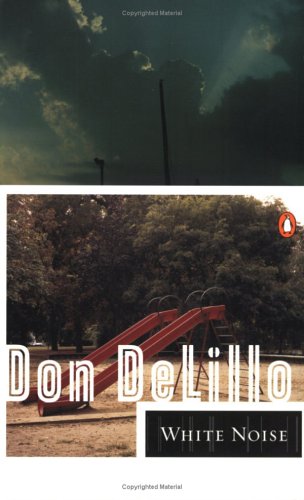
WHITE NOISE (BY) DON DELILLO

Published 1985, 326 pages
Characters: D 
Writing: C+
Plot / Pacing:  B
Poignancy: B+

White Noise is, in a sense, more about its writing style than its content. In this post-modern tale of a professor who teaches "Hitler Studies" and a mysterious "airborne toxic event" that threatens a small town, Don DeLillo's writing flutters along with airy characters and decontextualized situations; everything is in snippets, in abstractions, fighting to remove any overall coherency in the effort to create, well, white noise. White Noise is, and is about, the constant bombardment of trivial sounds and soundbites that make up the modern flow of information, our very mode of communication. It's also about the fear of death, how the reduction of everything to little bits of information turns even this basic, human emotion into an incomprehensible, unavoidable buzz in the air. By far DeLillo's best trick is the random insertions of dialogue from a nearby TVor radio — completely out of context one-liners delivered from an advertisement or newscaster that have no relation to anything, no introduction, no commentary. It's as if you're hearing them in the background while the rest of the scene unfolds, a clever post-modern method of conveying the problems with our post-modern society.

Unfortunately this same mood pervades the whole text, and with much reduced effectiveness. Apocalyptic catastrophe occurs with little fanfare or emotion, a subplot enduring only through the book's mid-section. The calamity is simply another event, given the same detail and urgency as mundane domestic turmoil, career-troubles, school-troubles, absurdest health concerns. Everything, here, is on the same level of urgency — the level of a newscaster droning away on television. As a concept, it's almost brilliant, giving DeLillo the opportunity to drop devastating commentary on society, to playfully skewer both our worries and solutions through deadpan, built-in satire — and it's as satire that this book excels.  Yet somewhere along the line, post-modernists seemed to decide that they could forgo endearing characters and a readable story, just as long as their satire made its point.  But a satirical novel is still a novel, after all, and no book is excused for ignoring its foremost assets — its characters. In White Noise, everything is post-modern, lightweight and inconsequential. White Noise might have been better as an experimental personal essay, because at least then DeLillo wouldn't have had to pretend to give his creations some semblance of life.

Down to the dialogue, our protagonist and his family are maddeningly consistent to the rest of DeLillo's post-modern monotony — the exact tone, shade, texture, color and pattern of the novel, fitting in so seamlessly that, like the popular image of Zach Braff wearing his wallpaper-inspired shirt in Garden State, you almost don't notice them. It's admittedly not an oversight of the author, but exactly his intention.  This is his point, but it doesn't make it any more bearable.  By the time the book is over, the only character whose name I could recall was the wife, Babette, and only then because the main character keeps referring to her in the third person for no apparent reason, making her memorable not through characterization but through brute-force annoyance.  It doesn't help that White Noise is about as subtle as the mindless marketing that it's advertising, and just as clumsily written.  These characters deal with all their fears through relentless existential conversations, conversations that naturally never accomplish anything. It's understood that the dialogue is meant to be unrealistic — yes, I understand this, it was poorly written on purpose — and it accomplishes this perfectly.  See for yourself:
"I'm going running," she said.
"Is that a good idea? At night?"
"What is night? It happens seven times a week. Where is the uniqueness in this?"
"It's dark. It's wet."
"Do we live in a blinding desert glare? What is wet? We live with wet."
Everyone talks like this, even the couple's young children.  Maybe you're okay with the style.  Maybe you think it's genuinely witty instead of too-witty-for-its-own-good.  For me, the sentences above are like a drill to the brain, turning the novel into a shrill, clumsy, excruciating mess.  As the novel is not plot-driven and not particularly descriptive, there is obviously a great deal of dialogue, most of it unbearable. It's not only tedious but frustrating, as existentialism often is when it falls flat. 

Still, it would be unfair to bring the whole of the novel down to that level for the sake of a review. It wouldn't be accurate; there are a few truly memorable passages here, but they are few and far between. For the ideas, I thoroughly enjoyed this book — DeLillo really was on the right track, and White Noise certainly approaches brilliance more than once — but it was unnecessary and unclever for DeLillo to make his prose such a chore to get through.

Related Posts-