Sunday, December 26, 2010

THE TOP 10 ALBUMS OF 2010

10. Fang Island (by) Fang Island
Math Rock / Indie Rock / Everyone High-Fiving Everyone
Fang Island seems to be having such a good time playing their eclectic brand of math-rock that it's hard not to wonder if they aren't, you know, fucking with us. These dudes have the rare ability to make fun music without pandering, probably because fun rarely sounds this musically unique. Completely lacking in the hipster irony you'd expect since pop-punk died, Fang Island is as packed full of delicious post-rock textures as it is whiplash inducing riffage. 2010 was a year of fantastic summer albums, and Fang Island's little burst of relentless, guitar-driven optimism should be on everyone's playlist when warmer weather arrives.  Or really, when you just want to pretend.

9.The Wild Hunt (by) The Tallest Man On Earth
Folk / Singer-Songwriter / Blues
It's not important that Sweden's Kristian Matsson happens to sound like a very famous folk musician.  Pretty much every review of The Wild Hunt mentions it, but Matsson deserves all the recognition he gets for his own ample song-writing talents.  And really, it's not much more than obvious talent and a no-bullshit approach to folk that makes The Wild Hunt such a standout album. Matsson is a master guitar player, and his songwriting is tight, lyrical and concise. Confident, affecting, and yet very catchy.  There are few flourishes to the album, but it doesn't need them — Matsson's voice carries these blues, while his feverish fretwork provides the momentum.

8. Marrow of the Spirit (by) Agalloch
Dark Metal / Atmospheric Folk / Progressive
I had incredibly high hopes for Marrow of the Spirit — possibly higher than for any album in the last year or two.  Really, I was certain that any new Agalloch would take the Album of the Year spot, regardless what year it was released.  So for Marrow of the Spirit to land this low is actually a bit of a shock, though I may very well be undervaluing it at the moment.  Agalloch's albums are always unique and slow to unfold, each with its own defined personality; quintessential "growers."  This is a fantastic hour of music, full of haunting textured guitars and powerful, earnest soundscapes, though Agalloch's songwriting seems a bit less focused than on 2006's Ashes Against the Grain.  Possibly on purpose, since that feeling of openness and sprawl allows Marrow of the Spirit to avoid the claustrophobia of true black metal, even as the band occasionally dips into their bleaker roots.  It's a harsher, icer sound that mostly lacks the warmth of their last two albums, but still finds moments of serenity, redemption, and plenty of atmosphere, making this an album one might easily get lost in on a cold winter night.  Hell, even NPR loved it.
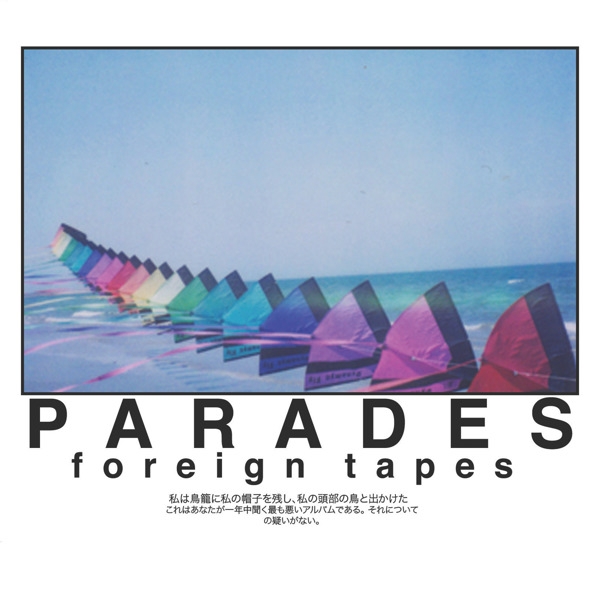
7. Foreign Tapes (by) Parades
Indie Rock / Math Rock / Pop
If you like Broken Social Scene's experimental-indie, jittery pop-rock aesthetic, but think they're a little too sprawling and "anything goes" to make a coherent album, then Foreign Tapes is just what you need.  This haunted summer album manages to hold on to a consistent tone throughout, though that's not to say that Parades doesn't reach to new and strange places.  Track to track, they throw dark, Zeppelin-ish riffs alongside intoxicating drum crescendos and frantically pounding electronics, male / female duet vocals, math-like guitar leads and blaring horns.  It's a strange but fluid menagerie, and shows a personality stronger than any I've heard in indie rock for a long time.

6The Fear Is Excruciating, But Therein Lies the Answer (by) Red Sparowes
Sometimes a band just needs a few albums to get it right.  That's clearly the case with Red Sparowes, who had never particularly impressed me before 2010.  With this, their third album, not much has changed on the surface — they just finally nailed it.  Songs are less meandering, more focused on melody, and Red Sparowes manages to give each track personality without losing the journey of the album as a whole.  Take "Giving Birth To Imagined Saviors," which features one of the best melodies I've heard in a post-rock song in years, or album-closer "As Each End Looms and Subsides," which has perhaps the best climax.  This is the rare case where I'm glad the band didn't try something more experimental, because everything falls into place so flawlessly.

5. Spiral Shadow (by) Kylesa
Sludge Metal / Psychedelic / Progressive
Kylesa may be one of the densest, heaviest metal bands out there, but somehow these Georgian guys and gal have managed to become one of the most accessible too.  On Spiral Shadow, their sound takes one giant evolutionary step into progressive metal. If the Melvins and Built To Spill decided, for some (awesome) reason, to form a super-band, it would sound like this. On first listen, it might seem as if the music is leaner, relying more on atmospherics and psychedelia, but it's more likely that Kylesa just learned how to cram their hundred influences into every moment of riffage.  Psychedelic guitars spiral and bounce back and forth; everything else rumbles along with that good-old buzzsaw crunchiness.  Aided by more forward male / female dual vocals, songs like "Don't Look Back" sound like they could have been radio hits in the early nineties.  It all makes for more opportunities to air-guitar (and double air-drum) than ever.

4. Kvelertak (by) Kvelertak
Metal / Punk / Black'n'Roll
When I first laid eyes on that amazing John Baizley album cover, I figured I was in store for something good, but beyond the Baroness' Stamp of Approval I had no idea what to expect.  Certainly not an Object Lesson in how metal can be unironic, unrestrained, and fun. If Converge gave you the chance to figure out just what the hell was going on before you got knocked out, it'd be this: black'n'roll, punk metal, blackened punk with a dose of sludge. You know how sometimes you're listening to a band that has so much energy, you can't help but appreciate how vibrant and exciting the world can be, and you just want to run up to the nearest person and punch them in the face?  That's this.

3. Dust Lane (by) Yann Tiersen
"French," as a genre tag?  Yes.  I maintain that a few countries are their own genre — somehow, through whatever instruments become standard and whatever cultural associations happen over time, some countries just have a vibe.  The same way you can listen to gritty slide-guitar and instantly conjure images of the southern states of America, something about France has created a tone unique in the world of music.  Yann Tiersen is of course no newcomer — most would probably know him as the composer of the Amelie soundtrack, something which is very, very French.  Tiersen is known for his quirky, folky neo-classical compositions, but Dust Lane shouldn't be taken as anything other than an indie-rock album.  And it's an odd album, to be sure, just not in the way Tiersen's fans may be used to.  Every song features vocals, though most are not exactly singing — Tiersen's voice mixes with that of a female guest in a series of echoey, monotone monologues that somehow fit these songs perfectly.  The mood is dense and yet spectral, the songwriting nearly impossible to pin down for style.  Many indie bands sound like they're throwing a dozen instruments at you just because they can, but Tiersen never shows off; he's just using the right tool for the job, whatever it is he's doing.  A combination of things that are entirely familiar in-and-of themselves, yet produce a sound unlike anything else out there. 

2. Septembre Et Ses Dernières Pensées (by) Les Discrets
If you've been following the underground French music scene over the last few years, you may have witnessed a rare event: the birth of a genre.  It started with Neige, of Alcest, who realized that shoegaze is basically reverse black-metal — and with that wistful French aesthetic and a good dose of folk drizzled on top, you have a style that can't be described with any existing genre tag.  Now, a few years later, Neige's buddy Fursy Teyssier has formed Les Discrets and pushed the music further away from its black metal undertones and deeper into some strange folk / post-punk fantasyland.  Some have started calling the scene "blackgaze," and it's as fitting as anything else. There's a sense of darkness and mourning to Septembre Et Ses Dernières Pensées, the tone a Grimm's Fairy Tale would have if converted into music. It's dense, too, but that brings us to the shoegaze, the thick, eerie post-punk sound. That the lyrics are all in French only adds to the atmosphere, as Fursy's voice drifts through songs like a dense but small fog, sometimes joining a female vocalist to brighten the atmosphere without abandoning melancholy.  The album occasionally seems hurried to deliver, but when Fursy takes time to slow the narrative and open up each piece, Septembre Et Ses Dernières Pensées displays some of the most beautiful, surreal sounds I've ever heard.

1. Gifts From Enola (by) Gifts From Enola
Post-Hardcore / Post-Rock / Progressive 
When I reviewed last year's phenomenal From Fathoms, I spent some time trying to figure out just what makes Gifts From Enola so memorable and fresh, for what seems at first like standard guitar-driven post-rock. But by now, it's obvious that post-rock was a red herring.  Surprise!  Gifts From Enola is actually an instrumental post-hardcore band that happens to have a love for post-rock atmospherics.  While From Fathoms remains my favorite of their albums — it's more sprawling and more of an adventure, and I happen to like every detour it takes — the Gifts guys wisely acknowledged their sudden identity-acceptance with this self-titled.  The meandering post-rock subtleties of their very early material is mostly gone, replaced by confident, denser songwriting and nuclear stockpiles of energy.  Vastly improved production values help showcase that unbridled hardcore adrenaline, but these songs would still sound relentless if Justin Bieber's backup band covered them.  This album could hurt you.  Drums are pushed way up in the mix, thudding and propulsive as a cannonade; each hit sounds like something died as a result.  Every bass line sounds something you'd pay money to ride.  The guitars drive it all to a breakneck pace, and remain some of the most versatile in any scene, instrumental or otherwise.  Nothing is outright super heavy — there are no breakdowns like in last year's monstrous "Trieste" — but only because the songs move too fast, mixing grittiness with serenity, and often at the same time.  Take Alagoas, which has quickly become one of my favorite songs of all time (and probably would have been my Album of the Year even if they'd released it as a single.)  The song is a perfect summary of everything Gifts From Enola does so brilliantly, without being too flashy about it.  I can't think another post-rock or post-metal band that's able to conjure as many fantastic riffs as these guys, and still spin that guitar-driven density into something that's also multi-layered, suggestively textured and fully coherent.  For every shift and switch-up, the music never loses focus, and Gifts' personality is clearer than ever before.  It may not be their most ambitious album, or even a perfect one, but this is unquestionably their defining album.  Gifts From Enola's music has a remarkable vitality, the ability to sound fresh and interesting even after dozens and dozens of repeated plays.  An achievement like that takes more than creative genre-bending, or even passion.  There's no equation I can think of to give a record such energy — but whatever it is, Gifts From Enola has it.

Monday, December 20, 2010

THE TOP 10 ALBUMS OF 2009, IN RETROSPECT


It's become a sort of obligatory internet tradition for music sites to post their "best of" lists at the end of each year.  I enjoy the tradition as much as anyone, but I'll be the first to admit that it's a flawed concept.  Once music passes a certain point — arriving in the mercurial netherworld of Objectively Good Music — it becomes extremely difficult to critique or compare it without stumbling through the magical wardrobe of Extreme Subjectivity.  If you've found ten albums from a year that were all excellent, what makes any one of them better than the others, except that you liked it more?  Past a certain point, your own personal appreciation is all that matters.  Thus new music often goes through a cycle: discovery, heavy rotation, over-exposure, then sitting around for weeks without another play.  This makes it hard to decide what albums even you yourself really liked at the end of a year, since some of them may be fresh releases, while others have been in your collection for nearly a year already.

That's why, here at The Luxury Yacht Review, I'm going to take the time to check back in a year later and re-evaluate what lasted the test of time — and what albums I may have simply missed the first time around, despite my best efforts to listen to everything and anything. And I will also admit — many albums I listened to in 2009 just didn't hit me until much later.  But now is the time to make amends.  In retrospect, 2009 was one of the best years in history for my music collection, though I scarily realized this last year.  My favorite albums from last year just became favoriter, and releases I only discovered after my list was compiled ended up blowing me away just the same.

Here is my Best Of 2009, as it stood last year:
1. Sol Eye Sea i (by) Irepress
2. Daisy (by) Brand New
3. From Fathoms (by) Gifts From Enola
4. Gin (by) Cobalt
5. Hollow Be My Name (by) Eleventh He Reaches London
6. Sunden (by) The Waters Deep Here
7. Dyad 1909 / Found Songs (by) Olafur Arnalds
8. Axe to Fall (by) Converge
9. The Other Truths (by) Do Make Say Think
10. Eras (by) Apse

It was an okay list, full of albums that impressed me with their originality and innovative genre blending.  But technical merits don't always equal lasting, emotional resonance, and with the discovery of a few newcomers (that is to say, albums from 2009 that I only discovered in 2010), my list looks quite different today.  But one thing hasn't changed: the top half of the list was extremely hard to rank, and any of my new "top 4" albums could trade blows and take the Album of the Year slot.  Many of these albums have settled into my record collection as all-time classics.  So here it is, my revised Best of 2009.

1. Sol Eye Sea i (by) Irepress
2. From Fathoms (by) Gifts From Enola
3. Blue Record (by) Baroness
4. Daisy (by) Brand New
5. Gin (by) Cobalt
6. Axe to Fall (by) Converge
7. The Great Misdirect (by) Between the Buried and Me
8. By the Throat (by) Ben Frost
9. The Other Truths (by) Do Make Say Think
10. Hollow Be My Name (by) Eleventh He Reaches London

Baroness' Blue Record first grabbed me only a week or so after I published my original Best of 2009, yet quickly blew away almost everything else on that list.  From January to March of this year, I listened to pretty much nothing but.  In any other year (including 2010, actually), it would easily grab Album of the Year status.  The Blue Record is like a sludge-metal version of Led Zeppelin III, just faster and denser and heavier.  This is perhaps the pinnacle of the booming Georgian metal scene, a perfectly written, relentlessly energetic bombardment of rock.  Pretty much an all-time classic.  The Great Misdirect is another album I was unfortunately late to the party on.  Over six songs and one hour, Between the Buried and Me races through a half dozen genres and more switch-ups, solos and tangents than I could possibly keep track of.  You might find this sort of restless, ADD musicianship unfocused, and maybe it is.  Maybe The Great Misdirect will never go down in history as an example of pioneering song-writing, but that doesn't stop it from being a hell of a lot of fun.  In spite of its eccentricities, The Great Misdirect still sounds more grounded than the majority of progressive metal, maybe thanks to its earthy, gritty textures.  Ben Frost's By the Throat sounds like it could be the soundtrack to a profoundly disturbing film — could be, though it's already the most frightening album I've ever heard.  The soundscapes you'll find here are blacker than the blackest black metal without laying down a single guitar riff — instead, Ben Frost crafts an subtle, ambient story of sounds, creaking violins and throbbing electronic bass.  This isn't an album you should listen to for entertainment — or alone in the dark — it's an experience.

Thursday, December 16, 2010

FULL DARK, NO STARS (BY) STEPHEN KING

Published 2010, 364 pages
Characters: B
Writing: B-
Plot: B
Pacing: B+
Poignancy: B

At this point in his career, Stephen King has nothing else to prove. As a "popular" author, King gets very little credit for just how versatile and innovative of a writer he is — though after his dozens and dozens of novels, he can be forgiven for sticking to "competent, consistent but unadventurous," which is how I would describe this new collection of four novellas.  While King doesn't attempt to dazzle with creativity, his mastery of the short form is evident.

Did you like The Shawshank Redemption? How about Rob Reiner's classic coming-of-age tale, Stand By Me?  Add in a slightly less well-known film, Apt Pupil, and you have the three movies based on three of the four novellas in Different Seasons, one of King's earlier novella collections.  Not a bad track record.  Though the nine-billion page The Stand is possibly King's single best work, he's at his most consistent with the medium-length style.  King's major flaws are less grating in his shorter fiction, and he makes efforts to subdue them altogether in Full Dark, No Stars, mostly by toning down the ambition.  It works, to some extent — the four stories here are all perfectly competent and enjoyable to read, despite their grim, off-putting subject matter.  But the darkness running throughout these tales mostly just hides the fact that there's little drama or tension.  The good guys (actually, good women, so far as it applies here) don't have too much trouble resolving their hideous problems, and the simplified conclusions are just a little too convenient.  It's not a major blow, but the material in Full Dark is just not as memorable as anything in Different Seasons, making this a satisfying read, but far from essential.

The best tale here is the first one, "1922," and the closest the collection comes to classic horror.  Each of these stories is about murder, to some extent, and "1922" deals with the subject most directly, by dropping us into a first-person account of a Kansas farmer who felt he had no choice but to kill his wife.  King gets a lot of mileage out of the rustic countryside atmosphere, helping the surreal ending stick its landing, and the story takes a few interesting turns along the way.  "Big Driver" — your basic "Hey lady, don't take that deserted country road shortcut home, you might blow a tire and run into some creepy yokel!" tale — is perhaps the darkest of these stories, but its bleak subject matter makes its convenient, all-too-easy ending feel mostly justified.  "Fair Extension," a "make a deal with the devil to cure your cancer" story, is short, simple, and gleefully perverse — and makes its satirical simplicity work for it, by simply leaving off just when you think King would be forced to give the plot another twist.  Much like "Big Driver," "A Good Marriage" ends a little too conveniently, but its simple intentions make for an interesting psychological experiment.  It's an earnest examination of all the little things one knows about a person after years of intimacy, and the way larger, darker truths can still slip through the cracks.

Though everything works well enough, nothing works itself into your mind the way the best King stories do.  Some of his more annoying writing habits pop up too often — King is excellent at writing about average people, and his characters are often more fully-fleshed than those of most literary darlings, but he still relies far too much on hokey inner-monologues and witticisms.  King's characters all think in goofy puns and folky nonsense-phrases that they just love to repeat to themselves.  But aside from that, King remains a fluid, clever writer, and unlike the majority of his peers, remains impressively self-aware of his strengths and limitations even after decades of dominating sales charts.

Wednesday, December 15, 2010

THE LAST AMERICAN MAN (BY) ELIZABETH GILBERT

Published 2002, 268 pages
Characters: n/a
Writing: B
Plot: B+
Pacing: B+
Poignancy: B+

It's rare to find a biography as thorough and intimate as The Last American Man.  Of course, there aren't many subjects out there like Eustace Conway.  Since a very young age, Conway has taught and lived self-sufficient living, but he's more than just a naturalist and mountain-man.  He's a man that can conquer seemingly any goal he sets for himself, a man that seems to have nearly superhuman physical powers, and a mind to match.  At the age of seventeen, Conway left his parent's suburban home, built a tee-pee in the wilderness, made all his clothing out of deer-skin, and has more or less lived like that ever since.  Conway's is a complex story that could have easily been told through a lens of hero worship and idealism, but Gilbert does an excellent job of unraveling Conway's complicated motivations, aspirations and frustrations. The two have been friends for years, and it shows in her writing, which is deeply personal — affectionate, yet candid and critical.  In trying to demystify this man — who has already become a legend to many — Gilbert leaves out nothing.  No one this passionate achieves success without having a dark side, and The Last American Man takes the psychoanalytical risks to show why so many people idolize Conway from afar, then practically flee when given the opportunity to know him up close.

Eustace Conway is the owner of Turtle Island, a nature conservatory and ultra-primitive, self-sufficient farm in North Carolina; a sort of non-profit haven for preaching and teaching his message of environmentalism.  Yet despite building and running his own utopia from the ground up, Conway doesn't seem to stay in one place for very long.  He has broken multiple world records for long-distance horse riding and hiked the entire Appalachian Trail with only a small knife, wearing a loin-cloth.  He makes his own clothing out of animal skin.  He's hardcore, to the say the least.  Many would be quick to pin him as a hippie, a bleeding-heart liberal tree-hugger.  But Eustace Conway turns out to be far more complicated than that.  For one, he's shockingly conservative, and a brilliant businessman with a head for self-promotion.  He's a strict authoritarian, and often complains that he would run Turtle Island like a rigid military dictatorship if he could.  A man like Conway couldn't achieve success without being a control-freak.

While reading The Last American Man, it struck me how similar Conway's basic personality traits are to those shown by Mark Zuckerberg (as he was portrayed by Jesse Eisenberg) in The Social Network.  The lives of these men would seem to have little in common on the surface, yet both embody the same relentless drive, the need for absolute control, the perfectionism, the uncanny intellect and talent — and as a result, the tendency to drive away everyone close to them through the sheer intensity of their personality.  These men were born to succeed beyond measure, but might as well wear a plaque around their neck that reads: "... at what cost?"  What makes The Last American Man (and Eustace Conway) so fascinating is not just the adventures Conway has been on, but the way people react to him.  This includes the author, who can't seem to help interjecting her own thoughts and witticisms into the narrative, especially when deconstructing Conway's personal relationships (though to be fair, this might just be her writing style.)  That Gilbert is fascinated and perplexed by Conway even after knowing him so well — indeed, after writing such a thorough book on the man — is telling.  Many of the apprentices that come to Turtle Island to learn about the primitive life seem to look to Conway as a father figure and spiritual guide, and most end up leaving disappointed, jaded and even heartbroken.  Conway has had poor luck with his sexual relationships as well, though he seems to have had no lack of them either.  He is a man who is immediately and obviously compelling, who is described as constantly drawing people into his orbit before suffocating them through the intensity of his personality, the extreme demands he places upon himself and others.

As a book, The Last American Man is not perfect.  Gilbert's intimacy with Conway gives the reader access that few authors would have been able to obtain, or understand, but her tone is occasionally so casual that it's hard to take at face value.  Still, for this style of writing, she could do much worse, and the book has a nice flow and a vibrant, excited energy to match its subject.  The pacing suggests Conway's own trajectory, from capable young idealist to jaded, disappointed businessman.  This, in a way, makes The Last American Man an unintended but insightful commentary on the very nature of idealism, structured around an idealist who did not himself fail, like so many hippies and would-be-Utopians.  Eustace Conway tackled every goal he set up for himself, and he had just as high hopes for America — he truly believed he could save our country by teaching us how live a primitive, knowledgeable, hard-working lifestyle.  He really figured out how to do it, showed us that it works.  But most people are not like Eustace Conway, and the same problems he saw in his youth are looming larger than ever.  Watching this man recognize his own futility through the pages of a mere biography is a tremendously fascinating experience.

Wednesday, December 8, 2010

KORZO HAUS

Middle-European / Hungarian / American
178 East 7th Street (between Avenues A & B)
New York, NY 10009
[CASH ONLY]

Korzo Haus is tiny.  Nearly everyone that I've gone there with has immediately commented: "Wow, it's even smaller than I thought."  Yet Korzo is not meant to feel exclusive, just intimate.  There are only around ten tables, and Chef Steven Reese cooks from a small kitchen area exposed to the rest of the restaurant.  Of the three times I've eaten at Korzo, all on weeknight evenings, it's never been packed.  Partly this is due to Korzo's recent opening, and its minimalist exterior practically hidden behind scaffolding on the south side of Tompkins Square Park.  The contemporary-rustic, vaguely-Germanic facade is a good indication of the menu, but Korzo Haus has enough surprises in store to make it one of my favorite little-known secrets of New York City.

The main attraction — at least for a poor freelance writer like me — is Korzo's weeknight dinner special.  From Monday to Thursday, 2 pm to 7 pm, order one of Korzo's house burgers and a pint of beer for only 10 dollars.  Now, already that's a great deal, but a deal that I've found other places — and restaurants with cheap food deals are usually cheap for a reason.  Not here.  Few burgers in New York, regardless of price, are in the same ballpark with Korzo on quality.  These burgers are thick and packed with flavor — nor do they skimp on the fries, or even the red cabbage, or apple slivers.   Korzo's menu is always changing, but two burgers are currently included in the 10 dollar beer & burger deal: the Korzo Burger and Haus Burger.  Better yet, there are two ways to have them prepared.  (Not only is it a cheap burger, it's also unique and innovative!)  The Korzo Burger, served as suggested, is deep-fried in Lángos dough along with apple-smoked bacon, Allgäuer Emmentaler cheese, mustard and pickles [pictured, with sides.]  It's an interesting tactic for serving a burger that I've never seen anywhere else, but it doesn't mean your meal comes out as a greasy, sopping mess — on the contrary, the deep-fried shell around the meat keeps things neat and firmly encased, so there's no leaking or sliding around as you bite in.  Which is good, because Korzo doesn't skimp on the beef, which is juicy and perfectly prepared.  The Korzo Burger is easily one of the tastiest burgers I've had anywhere.  If the deep-frying has any effect beyond practicality, it's to give the burger a richer, saltier flavor than you might be used to.  You can, of course, have it served traditional — you know, between a bun — though I preferred the deep-fried treatment.  (The Lángos dough is tasty enough on its own, and can be ordered as a side with cheese.)  Even the beer is a great deal: while Korzo features only two on tap, their "Korzo Organic Ale" is a unique recipe that Korzo came up with in cooperation with Peak Organic.  It's a crisp, not-quite-pale ale with enough bite to accompany a rich entree, but that holds back on the hops so as not to compete with your food.

Though I preferred the Korzo Burger, the Haus Burger is also tasty and theoretically healthier, and can be deep-fried on request. Other burgers come and go depending on the day, including a brat, a vegetarian portobella option, and an experimental new burger called the "Slav" (which is sadly not included in the 10 dollar burger deal).  A combination of beef and pork, I really recommend getting the Slav deep-fried to contain its other toppings: bryndza cheese, house-made sauerkraut, caraway seeds and most interestingly, juniper berries.  That might seem a little strange, but the berries add a slightly bitter crunch that compliments the rest of the burger well.  It's a great example of Korzo Haus' aesthetic, and flexibility to adjust its menu on the fly.  The restaurant is so small that chef Steven Reese can make menu decisions based on what he finds at the local market.  Korzo has even begun a menu selection called "Village Choice," where locals make daily requests through Facebook or Twitter — Reese will pick one and serve it.  A focus on fresh, local ingredients makes this possible, and makes the small menu work as well as it does.

I have little to complain about when it comes to Korzo; I've had a great dining experience each time I've gone.  Service is casual but prompt, and everyone is friendly, especially Reese.  I could always wish for more beers on tap, but a diverse bottle selection helps make up for it.  Though the restaurant is small, I really like its simplified, rustic aesthetic and general atmosphere of calm and quiet — rare in NYC, where "calm and quiet" is usually an indication of sky-high prices, or suspect quality.  The seats are slightly uncomfortable, but I wasn't paying attention to my stool as long as there was a burger in front of me.  Korzo aims to be a low-key neighborhood establishment for the Village, yet despite living a few train transfers away, I will keep coming back.

Related Posts-