Wednesday, May 14, 2008

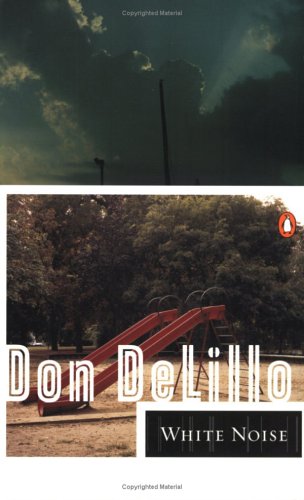
WHITE NOISE (BY) DON DELILLO

Published 1985, 326 pages
Characters: D 
Writing: C+
Plot / Pacing:  B
Poignancy: B+

White Noise is, in a sense, more about its writing style than its content. In this post-modern tale of a professor who teaches "Hitler Studies" and a mysterious "airborne toxic event" that threatens a small town, Don DeLillo's writing flutters along with airy characters and decontextualized situations; everything is in snippets, in abstractions, fighting to remove any overall coherency in the effort to create, well, white noise. White Noise is, and is about, the constant bombardment of trivial sounds and soundbites that make up the modern flow of information, our very mode of communication. It's also about the fear of death, how the reduction of everything to little bits of information turns even this basic, human emotion into an incomprehensible, unavoidable buzz in the air. By far DeLillo's best trick is the random insertions of dialogue from a nearby TVor radio — completely out of context one-liners delivered from an advertisement or newscaster that have no relation to anything, no introduction, no commentary. It's as if you're hearing them in the background while the rest of the scene unfolds, a clever post-modern method of conveying the problems with our post-modern society.

Unfortunately this same mood pervades the whole text, and with much reduced effectiveness. Apocalyptic catastrophe occurs with little fanfare or emotion, a subplot enduring only through the book's mid-section. The calamity is simply another event, given the same detail and urgency as mundane domestic turmoil, career-troubles, school-troubles, absurdest health concerns. Everything, here, is on the same level of urgency — the level of a newscaster droning away on television. As a concept, it's almost brilliant, giving DeLillo the opportunity to drop devastating commentary on society, to playfully skewer both our worries and solutions through deadpan, built-in satire — and it's as satire that this book excels.  Yet somewhere along the line, post-modernists seemed to decide that they could forgo endearing characters and a readable story, just as long as their satire made its point.  But a satirical novel is still a novel, after all, and no book is excused for ignoring its foremost assets — its characters. In White Noise, everything is post-modern, lightweight and inconsequential. White Noise might have been better as an experimental personal essay, because at least then DeLillo wouldn't have had to pretend to give his creations some semblance of life.

Down to the dialogue, our protagonist and his family are maddeningly consistent to the rest of DeLillo's post-modern monotony — the exact tone, shade, texture, color and pattern of the novel, fitting in so seamlessly that, like the popular image of Zach Braff wearing his wallpaper-inspired shirt in Garden State, you almost don't notice them. It's admittedly not an oversight of the author, but exactly his intention.  This is his point, but it doesn't make it any more bearable.  By the time the book is over, the only character whose name I could recall was the wife, Babette, and only then because the main character keeps referring to her in the third person for no apparent reason, making her memorable not through characterization but through brute-force annoyance.  It doesn't help that White Noise is about as subtle as the mindless marketing that it's advertising, and just as clumsily written.  These characters deal with all their fears through relentless existential conversations, conversations that naturally never accomplish anything. It's understood that the dialogue is meant to be unrealistic — yes, I understand this, it was poorly written on purpose — and it accomplishes this perfectly.  See for yourself:
"I'm going running," she said.
"Is that a good idea? At night?"
"What is night? It happens seven times a week. Where is the uniqueness in this?"
"It's dark. It's wet."
"Do we live in a blinding desert glare? What is wet? We live with wet."
Everyone talks like this, even the couple's young children.  Maybe you're okay with the style.  Maybe you think it's genuinely witty instead of too-witty-for-its-own-good.  For me, the sentences above are like a drill to the brain, turning the novel into a shrill, clumsy, excruciating mess.  As the novel is not plot-driven and not particularly descriptive, there is obviously a great deal of dialogue, most of it unbearable. It's not only tedious but frustrating, as existentialism often is when it falls flat. 

Still, it would be unfair to bring the whole of the novel down to that level for the sake of a review. It wouldn't be accurate; there are a few truly memorable passages here, but they are few and far between. For the ideas, I thoroughly enjoyed this book — DeLillo really was on the right track, and White Noise certainly approaches brilliance more than once — but it was unnecessary and unclever for DeLillo to make his prose such a chore to get through.

Tuesday, May 6, 2008

LIES MY TEACHER TOLD ME (BY) JAMES LOEWEN

I could not ignore a book with such an accusative title as it lay before me at the bookstore. A book of revisionist history could go either way, and while I'm not sure if I got what I was expecting, or even what the cover promised, I'm glad for its enticing siren-song. Now released again in hardcover for one of its umpteenth reprints, this revised version of the 1995 original is a national best-seller and certainly much more than a gimmick; from what I can tell, it's been extremely influential to its field. This is a book that should be read, even if said title is a bit misleading. A more accurate title would be "The Unspoken History of Racism in America; Or, White Guilt is a Pretty Goddam Complicated Issue." Loewen's criticism is actually mostly reserved for the history textbooks and the highly dubious publishing methods and ghost-writers that create them—not, in fact, the teachers who teach them, most of whom are themselves ignorant of history, as they are often simply gym coaches and other plug-in history amateurs attempting to hold their own in the most unpopular of high school classes.

Towards the end of the book, Loewen goes through the process of textbook creation. He finds that the authors on the cover—often noted historians or important college professors—almost always had nothing to do with the actual writing process. Either their names were rented or bought for the illusion of credibility, or they wrote some early edition back in the 50's. In many cases, the "authors" have no ideas what the books actually say, and when Loewen introduced them to certain sections that they allegedly wrote, they were shocked and horrified. The true authors are invisible, unaccountable, and often themselves ignorant of history, simply copying, pasting and rewriting from one another to create a bland blend of "facts" that grow more muddled and PC over the years. The idea, which the author argues convincingly, is not that there is some conspiracy of rich white men dictating what patriotic factoids students are allowed to be taught (which he defensively suggests is a ridiculous and nonsensical idea), but simply a result of the textbook adoption process. School boards want books that will not receive complaints, that will inspire patriotism and make students feel good about their heritage. As anyone who reads the newspaper and takes note of frivolous lawsuits knows, parents these days are an uppity lot. So it's fairly understandable, but as statistics and the students themselves show, this bland white-washing of history, erasing our country's tumultuous and often cringe-inducing heritage creates a boring, irrelevant piece of propaganda that students instantly reject, either out of boredom, an inability to relate or a subconscious knowledge that what they're being fed is more synthetic and structured than a McDonalds hamburger.

The main bulk of the book is therefore a run-down of the sort of compelling historic narrative that the author argues is missing from our texts. If you have to wonder whether or not his point is valid, simply take the success of the book's contents—it certainly makes for an engrossing, engaging read, and I covered it's 400-odd pages in three or four days. That in itself should make the case for the books validity, but naturally it's more complicated than that. As with the title, the book's aim is somewhat ambiguous, because it is neither a straight-forward critique of the textbooks themselves, nor is it "filling in the blanks" by acting as a stand-alone history textbook. It falls somewhere in between, with Loewen covering scattered chunks of America's history—only in areas he feels are relevant, however, as his objective is not to write an authoritative, complete history volume, but the idea of what one might be. He presents the sort of information the textbooks leave out, while at the same time quoting and critiquing the 20-or-so textbooks he has selected for reference. Therefore, because it's not a book of straight-up "missing information", it is written with a strong voice and quite a bit of opinion. His own take on history glares through, at times when it is not really needed, and not necessarily helpful. While there are few areas where I outright disagreed with him, he too often takes the opportunity to inject his authorial flavor into an argument that would have been just as well presented by simply dropping the facts and showing how the textbooks are overtly manipulative.

Loewen is clearly distraught with the state of things, and despite his obvious opinions, he manages to avoid damning any one group of people. While he clearly leans to the left politically, his criticism usually only emerges where warranted—against any ethnic, political or spiritual faction. And while his conclusion seems to be that almost all textbooks are worthless, I don't think he even means to suggest that every issue or forgotten fact he mentions should be included in them. For example, the Pilim's were so hapless when it came to survival, so ignorant of how to living off the land, that at one point they took to digging up the corpses of Indians and eating them. The Indians, coincidentally, were all dead from the White Man's plague that swept through earlier. Middle-schoolers do not need to read about necrocannibalism. However, it is the tone that Loewen rages against, the absurd portrayal of the Native Americas as ignorant savages who "had never seen such a feast as the Pilgrims presented at that First Thanksgiving." As Americans, we need to understand that God did not simply drop us on this continent free of charge because a couple guys got together and prayed really hard. This country was not formed without struggle and injustice. America represents freedom to many, but even our freedoms have not always been on the side of right. Americans, and our politicians, can be both wrong and malicious.

Both the Civil War and the Alamo were conflicts we fought bitterly and many died for, to maintain freedom—in both cases, we fought and died to maintain the right to own slaves. Few have any idea that the Alamo was fought for this reason—its participants are American heroes, after all. Before Columbus landed, there were 100 million human beings living in the Americas. At the same time, the population of Europe was 70 million. Hundreds of millions died over the next five hundred years, many of them of disease, and in a very short amount of time. Granted, the Europeans could not have known what they were unleashing, but nonetheless they praised God for doing it for them. In many cases, if disease didn't suffice, they simply enslaved the native population—the Spanish were particularly brutal in this regard. We celebrate Columbus, oddly. He has his own holiday. And as most know by now, he was not even the first to discover the Americas, he was essentially the last.

Loewen excels at bridging connections from seemingly unrelated historical coincidences. For example, the Native Americans of the north were disease-free, for reasons I won't get into here. When Lief Erikson and other Scandinavians reached North America hundreds of years before Columbus, they did so out of their own northern countries, through Iceland and Greenland, passing through climates that germs did not tolerate, and essentially sterilizing themselves. They did not bring the plagues that later Europeans did, and therefore their presence did not result in a holocaust of early biological warfare. Given that the Vikings were essentially no more technologically advanced than the Native Americans they encountered, it's no wonder their colonization didn't take off. (To be fair, I suppose it's possible they just didn't pray as hard as Columbus did). I find this unfortunate, as we could today be speaking Norse instead, and celebrating International Viking Day and heading home to see our parents and exchange gifts for Plunderandpillage Week. Connections and historical debates like this highlight the fact that history is not simply a collection of known facts, but a dynamic, tumultuous subject that is neutral of moral and message, and all the more interesting for it. Students, Loewen demonstrates, would be more engaged by such a version of history, compelled to do their own research and ask questions, rather than simply memorizing dozens of meaningless and inconsequential factoids.

In conclusion: While certainly capable as a transport vessel, the yacht strives too hard to add the little touches typically representative of a pleasure-craft, and therefore handles a bit clumsily. In able hands it can hardly be faulted for its seaworthy-ness, but if left unattended the craft drifts slightly to port. The hull is of fine construction, though with some cosmetic oddities, and somewhat inefficiently streamlined. Overall a worthy purchase if one wishes for an enduring, steady ship, but not one to take out racing. Probably will not get you laid.

Related Posts-